



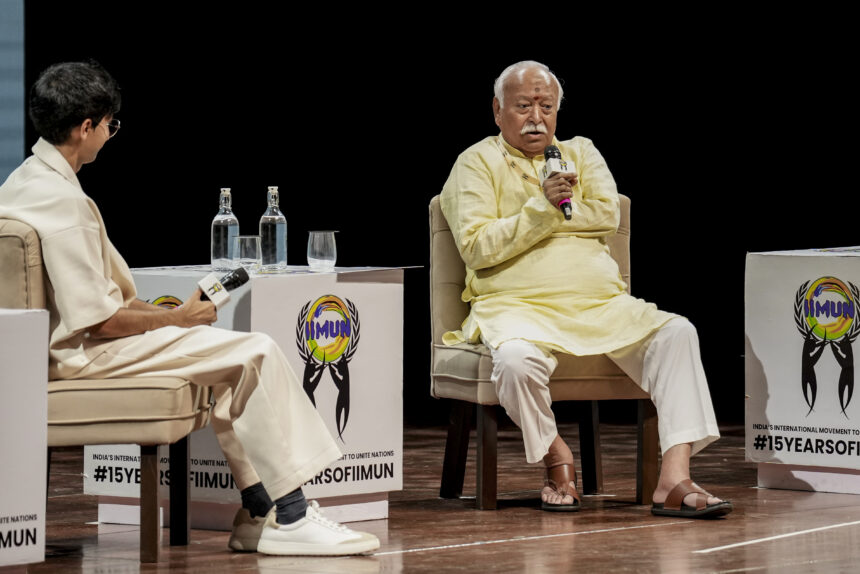
Mumbai: Rashtriya Swayamsevak Sangh (RSS) chief Mohan Bhagwat on Thursday came out strongly in support of Gen Z, saying their grievances are genuine and he believes in their honesty, insisting protests by young people do not make them “anti-national”.
He noted protest is a legitimate form of dialogue in a democracy and should be aimed at building consensus rather than creating divisions, comments coming in the backdrop of a recent stir by a fledgling pressure group on exam paper leaks.
Bhagwat said the concerns being raised over India’s education system are genuine and batted for increasing spending on the key sector to 6 per cent of the GDP.
“Protest is also a way of dialogue. In a democracy, protest is a way of building consensus. Different views come together and a consensus evolves after discussion,” he said, addressing a gathering of around 2,000 Gen Z and Gen Aplha members at India’s International Movement to Unite Nations (IIMUN) 15th anniversary event in Mumbai.
“If Gen Z members are agitating, they are not anti-national; they are our people. It is our next generation. You need a dialogue and rapport with them,” the RSS leader emphasised.
If, for various reasons, concerns are not heard through dialogue, people may turn to agitation, but the purpose of all this is to build consensus, not to create divisions, he stated.
“The Gen Z grievances are genuine and I believe in their honesty,” Bhagwat maintained.
Bhagwat’s interaction is being seen as the RSS’ most significant outreach to Gen Z (born roughly 1997-2012) and Gen Alpha (2013-2025) since the Cockroach Janta Party’s (CJP) protests over NEET paper leak culminated in Union Education Minister Dharmendra Pradhan’s resignation last month.
The BJP government’s handling of the protests, which turned violent during the July 20 march to Parliament in New Delhi called by the CJP, has invited criticism from different quarters.
Dialogue should always be the first step, Bhagwat insisted.
“There should be dialogue. What should happen if dialogue does not work can be considered later,” the RSS leader opined in response to a question posed to him during an interaction at the event.
He argued Gen Z seeks logical answers to their queries along with warmth and respect, unlike earlier generations that tended to accept what elders said without questioning.
Bhagwat maintained that during conflicts with countries such as Pakistan or China, citizens must stand with the government and the armed forces, but stressed that such situations should not permanently disrupt dialogue or people-to-people ties.
Responding to a question on whether people-to-people dialogue should continue during conflicts with Pakistan or China, he said, “In times of conflict, we have to go with whatever the government or military does. But that should not sever the ties which are already there.”
He noted India’s approach was not to “conquer or obliterate others” but to pursue a “harmonious assimilating process”, which required dialogue.
“During conflicts, dialogue can be halted, but conflict should not sever dialogue. After a conflict is resolved, we have to take it forward from where we left it. Permanent animosity or hatred is not the solution,” Bhagwat stated.
“When there is trouble, we have to deal with it in the proper way, and during conflict we are with our government and military. But it is a temporary situation arising out of politics. It is not that Pakistanis are wholeheartedly enemies of Indians or vice versa. The state, politics and international borders are facts of life,” Bhagwat said.
Warning about the misuse of technology, the RSS chief said people should not trust content on social media without verification.
“Today, technology can create fake videos using our faces and voices. Knowing this, people should never believe anything on social media without verifying it from authentic sources,” he suggested.
Bhagwat noted social media influencers carried a responsibility towards their followers.
“If I am a social media icon and 10 lakh people follow me, it becomes my responsibility to ensure they do not end up in a problem by following me. That much wisdom is necessary,” he said.
Calling for self-regulation, he said the older generation should help the youth develop the wisdom to use social media responsibly.
“We need self-imposed discipline in using social media. Once that discipline develops, regulations will work effectively,” Bhagwat observed.
Responding to a question on whether India should ban social media for children (of certain age group) as has been done by some other countries, Bhagwat opined restriction was not the answer.
“If you ban something, it simply moves to the black market and spreads even more. The entire society has to respond to this challenge together. Only then will the government’s efforts succeed,” he said.
Bhagwat said he supported the demand to increase spending on education to 6 per cent of the GDP.
“Education is not a commercial business; it should be structured in such a way that it is available for all. Society should also contribute to improving the status of education,” the RSS chief said.
Employment does not only constitute jobs but also entrepreneurship, Bhagwat said while responding to a query on joblessness in the country.
On whether Indian civil society should invite students or citizens from Pakistan or China for dialogue, Bhagwat said such initiatives should not take place during periods of conflict.
“Not during the times of conflict. A conflict may be a military war or even terrorism. Terrorism is not only about terrorists of a radical group; there is a whole philosophy and policy behind it, a ‘thousand cuts’ approach. It is a hidden war and we have to treat it accordingly,” he said.

