



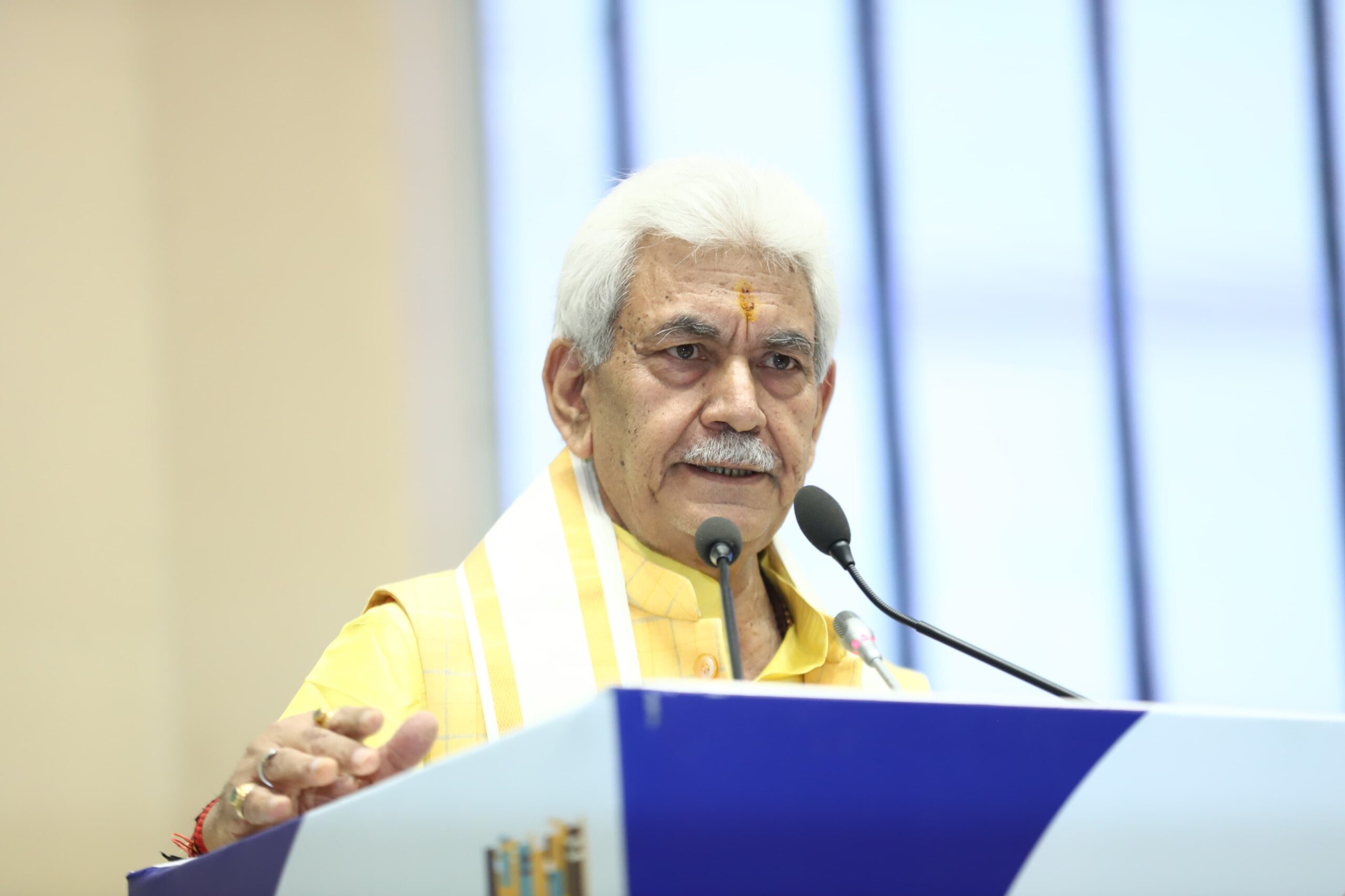
Jammu: Lieutenant Governor Manoj Sinha on Thursday highlighted the remarkable transformation in Jammu and Kashmir’s education sector, stating that schools, colleges, and universities in the Union Territory are now functioning without any disturbances. He asserted that the earlier practices of hartals, strikes, stone-pelting, and bandhs are now a thing of the past, and J&K is moving forward towards a prosperous and brighter future.
The Lieutenant Governor was addressing the Bharat Shiksha Summit, organized by the Balaji Foundation at Vigyan Bhawan, New Delhi. The event was also graced by Uttar Pradesh Deputy Chief Minister Brajesh Pathak, along with several eminent educationists, policymakers, and academicians.
During his address, the Lieutenant Governor elaborated on the various educational reforms that have taken place in Jammu and Kashmir under the guidance of Prime Minister Narendra Modi. He stated that over the past few years, significant efforts have been made to ensure inclusive and quality education for all students in the region.
“The talent pool within Jammu and Kashmir is being provided with better opportunities. Dedicated efforts have been made to promote multidisciplinary learning and skill development of youth. We have also actively initiated campaigns to bring dropout students back to school,” he said.
He further spoke about Mission Yuva, an initiative designed to foster an entrepreneurial culture among college and university students. The program aims to equip young minds with the skills and mindset required to become job creators rather than job seekers.
The Lieutenant Governor stressed the importance of values and ethics in education, stating that the National Education Policy (NEP) 2020 is designed to transform students into a living source of knowledge rather than just a repository of information from books.
“The NEP 2020 promotes creative imagination, ethical values, and a strong sense of determination to contribute towards building an equitable, inclusive, and pluralistic society,” he said.
He urged educational institutions to focus on developing well-rounded personalities in students—individuals who are not only innovative and proficient in modern skills but also deeply connected to their roots and sensitive towards social issues.
He introduced the concept of the Three ‘H’—Head, Heart, and Heritage—which, he believes, will help restore the moral fabric of the education system.
“Our students should be selfless individuals as well as skilled researchers, writers, or artists, deeply connected to their roots. This perfect balance in personality could be transformative for students, educational institutions, and society,” he said.
The Lieutenant Governor emphasized that education must not only focus on technological advancements but also on ethics and values.
“Without unprecedented inventions, moral values alone will have no value. But it is also true that without ethics and values, cutting-edge education and skills would be aimless,” he remarked.
He stressed that classrooms should foster conversations rather than monologues, and learning must be experiential and project-based. He called for linking innovation and growth with the ethical values of society and integrating them into the curriculum.
“The young minds should be exposed to real-world challenges. The time has come to take education out of the lab and into the real world,” he said.
Highlighting the improved academic environment in J&K, the Lieutenant Governor said that gone are the days when frequent disruptions such as hartals and stone-pelting impacted education.
He pointed out that educational institutions in J&K are now functioning smoothly, without any interruptions. He credited the government’s unwavering commitment to peace and development for this transformation.
“Earlier, hartals, strikes, and stone-pelting disrupted the education system in Jammu and Kashmir. But now, with stability and peace, our students are getting the opportunities they truly deserve,” he stated.

