



“Zero cybercrime cases MHA’s goal”
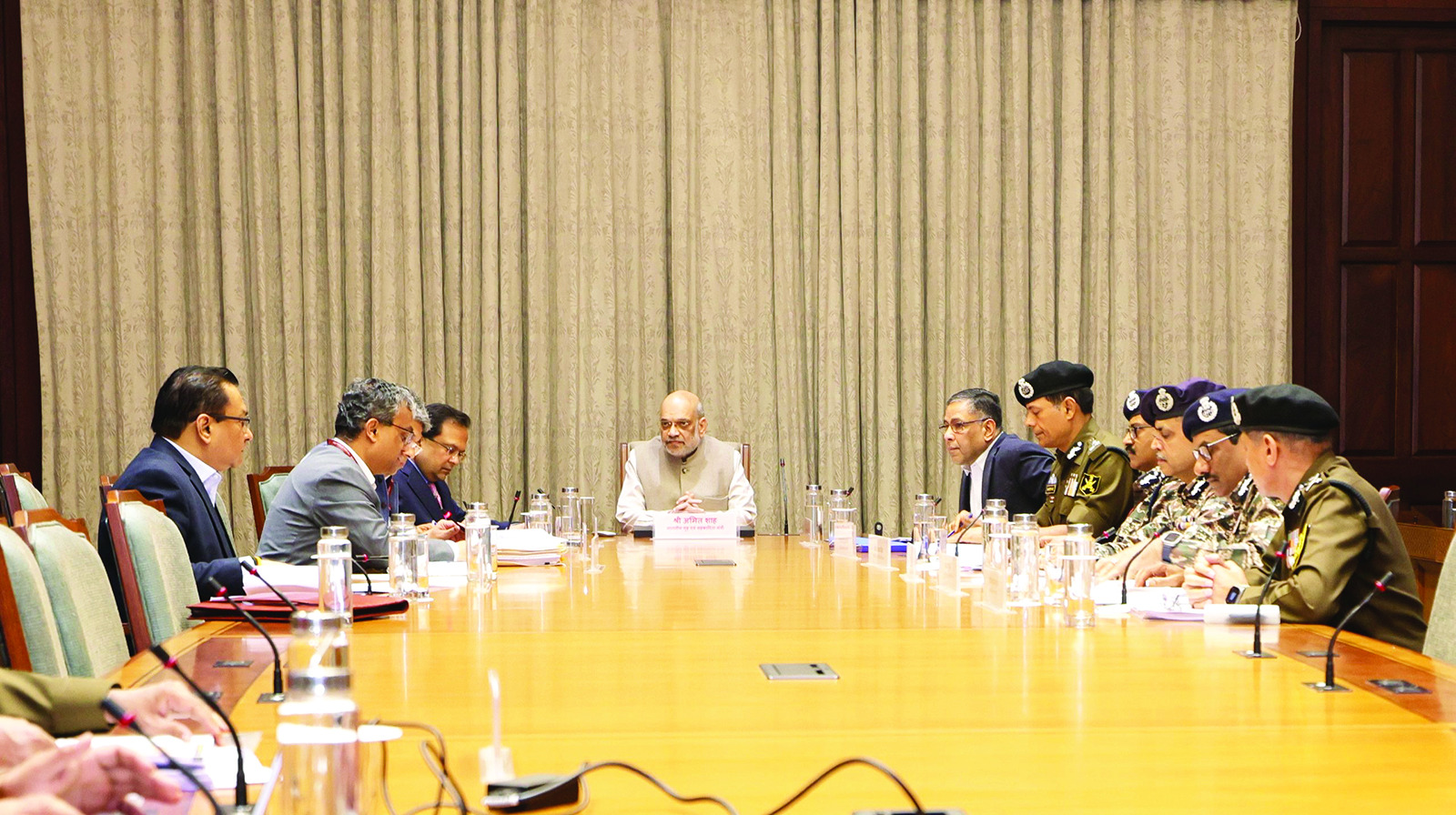
New Delhi: The central government under the leadership of Prime Minister Narendra Modi is committed to a terror-free Jammu and Kashmir, Union Home Minister Amit Shah said on Tuesday. Chairing a high-level meeting here to review the security scenario in J-K, Shah directed the Border Security Force (BSF) to ensure zero infiltration from the international border by adopting a strong vigil, strengthening the border grid and using advanced technologies for surveillance and border guarding.
He also directed the Central Reserve Police Force (CRPF) to continue with the synergy with the Indian Army and Jammu and Kashmir Police while carrying out its duties in the Union Territory (UT).
The home minister reviewed the winter action plan of the CRPF and directed the top officials of the force to ensure there are no gaps in area domination and focus on the Jammu region and dominate the heights.
Shah said under the leadership of Prime Minister Narendra Modi, the central government is committed to terror-free J-K, according to an official statement.
He emphasised the role of paramilitary forces in achieving the target of a terror-free J-K.
The home minister also reviewed the intelligence apparatus working in J-K and directed them to increase coverage and penetration to generate quality intelligence. He reiterated the importance of technology in intelligence generation.
Shah said monitoring of terror-financing, tightening grip over narco-terror cases and dismantling the entire terror ecosystem in J-K are the priorities of the Modi government. He said strong steps are being taken for a ‘zero terror plan’ in the UT.
He also directed focusing on countering the negative propaganda by the anti-national elements to place the correct picture in the public domain. He stressed continuing with the synergy amongst the agencies and guided for adopting technology and increase intelligence.
The home minister directed all security agencies to remain alert and continue work in a synergies mode to eliminate terrorism in J-K and assured that all the resources would be made available in this endeavour.
Tuesday’s meeting was in continuation of the high-level meetings with the Indian Army and J-K Police held on February 4 and 5.
Union Home Secretary Govind Mohan, Director of Intelligence Bureau Tapan Deka and other senior officers attended the meeting, the statement said.
Meanwhile, asserting that the Ministry of Home Affairs’ goal is to ensure zero cybercrime cases, Union Home Minister Amit Shah on Tuesday spelled out a multipronged strategy to tackle the fraudsters. Chairing a meeting of Parliamentary Consultative Committee for the Ministry of Home Affairs on the topic of ‘Cyber Security and Cyber Crime’ here Shah said, “To tackle cybercrime, we have adopted four types of strategies, which include convergence, coordination, communication, and capacity. All of these are being implemented with clear objectives and a strategic approach.”
Shah said that in recent years, there has been an expansion of digital infrastructure in India, which has naturally led to an increase in the number of cyber attacks. He said that when we look at cyberspace from a different perspective, it forms a complex network of ‘software,’ ‘services,’ and ‘users.’
He emphasized that until we consider controlling cyber fraud through ‘software,’ ‘services,’ and ‘users,’ it will be impossible to resolve the issues of cyberspace.
Shah mentioned that under the leadership of Prime Minister Narendra Modi, the Ministry of Home Affairs has taken several significant steps towards making India a cyber-safe nation.
The Union Home Minister said that cybercrime has erased all geographical boundaries. He stated that it is a ‘borderless’ and ‘formless’ crime, as it has no limits or fixed form. He mentioned that India has witnessed a ‘digital revolution’ in the last decade. Without understanding the size and scale of the ‘digital revolution,’ we cannot face the challenges in the cyber domain.

