



WAJAHAT SHABIR
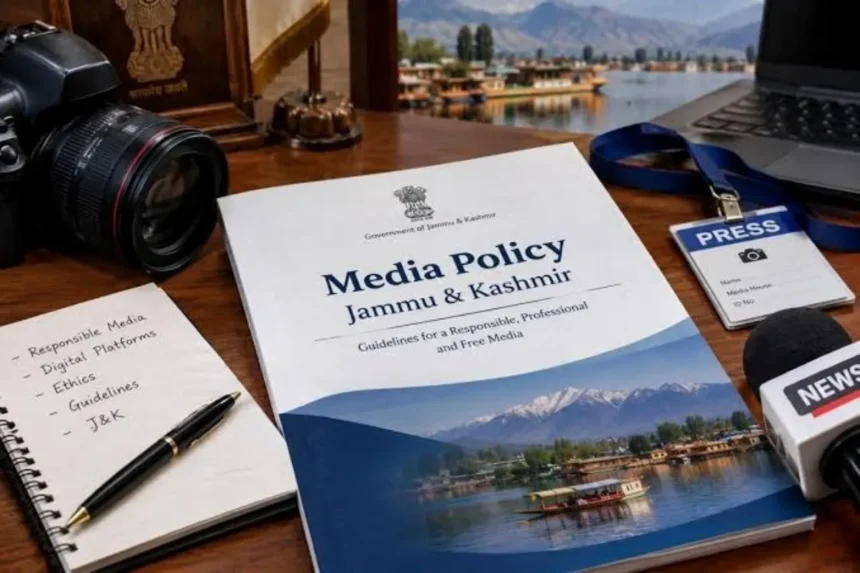
Srinagar: The Jammu and Kashmir Government will soon bring the New Media Policy 2026, providing for the registration and regulation of online news media platforms alongside print media, Information Minister Sakina Itoo told the Legislative Assembly on Wednesday.
Itoo said the policy was being prepared as part of the government’s commitment to address concerns surrounding misinformation, fake news, fabricated content and the functioning of unregulated social media news platforms.
She said the proposed policy would contain provisions for the registration and regulation of online news media platforms to ensure their accountability.
The minister further said that, in accordance with the directions issued during the July 13, 2026 meeting of the House Committee on Government Assurances, headed by MLA Ali Mohammad Sagar, the Information Department would also frame comprehensive guidelines and Standard Operating Procedures (SOPs) for dealing with unregistered social media news channels.
According to Itoo, these guidelines would mandate the respective district administrations to maintain detailed lists of unregistered social media news channels operating in their districts.
She said that if anyone was found spreading false, misleading or fabricated information through social media platforms, cases could be registered under the relevant provisions of the Information Technology Act, 2000, Bharatiya Nyaya Sanhita (BNS), 2023 and Bharatiya Nagarik Suraksha Sanhita (BNSS), 2023.
“These new laws contain provisions to penalize and manage the spread of misinformation, fake news and proactive content on social media platforms,” Itoo said.
She also informed the House that the Jammu and Kashmir Home Department has established the Jammu and Kashmir Cyber Crime Coordination Centre (JK-4C) as an independent organisation under the overall superintendence and control of the Director General of Police, J&K.
The JK-4C, she said, has been established for coordinating, preventing, detecting and investigating cyber crimes in the Union Territory.
Responding to questions from members, Itoo said the issue had already been discussed during the previous budget session in Jammu, when the Speaker had allowed a half-hour discussion on the subject and the government had responded.
She said the House Committee on Government Assurances, headed by Ali Mohammad Sagar, met on July 13 and gave the Information Department four months to draft a comprehensive media policy with structured guidelines.
“The department is actively working within that stipulated timeline,” she said.
Itoo said the concerns raised by members were legitimate, particularly because legislators and ministers were public figures and frequently became targets of social media content.
However, she said the issue also required introspection by elected representatives themselves. Itoo said members sometimes themselves encourage individuals to record video snippets inside the House with the intention of gaining political mileage outside.
She said the responsibility for misuse of social media could therefore not be placed entirely on media personnel.
In a pointed observation, Itoo said that, without naming the member concerned, an elected representative had allegedly created a social media page in the name of his wife’s domestic helper.
She said the content on that page included foul abuses, slander against ministers and vicious personal character assassination.
“If members themselves operate behind proxy handles to malign others, how can we solely fault external media?” she asked. In 1996, Doordarshan was the only broadcaster’
Recalling her own experience in the Assembly, Itoo said that when she first entered the House in 1996, Doordarshan was the only broadcaster covering Assembly proceedings.
She said people at that time wanted greater and fair coverage of the proceedings, whereas the media environment had now changed dramatically with the proliferation of Facebook portals, smartphone pages and other digital platforms.
Itoo said that an individual’s honour could be damaged within minutes through social media. She also pointed to the role of political party handles, saying that such handles could sometimes become involved in character assassination.
At the same time, she distinguished between credible registered journalists and what she described as the mushrooming of unregulated Facebook portals. Itoo suggests mobile phones be deposited before entering House
As one possible measure to prevent unauthorised recording and circulation of Assembly proceedings, Itoo suggested that mobile phones belonging to MLAs, people present in the galleries and persons in the press enclosures could be deposited outside the House chamber before proceedings.
She suggested that the phones could be returned after the session concluded.
The minister said such a measure could help address concerns over unauthorised filming and circulation of material from inside the Assembly. Itoo assured the House that the policy being prepared by the Information Department would include strict checks, rules and regulations.
She said the government was committed to bringing the framework within the four-month timeline prescribed by the House Committee. She further said that anyone found violating the proposed rules would face stringent legal action.
“Slander must stop,” Itoo said, reiterating that the government was firmly committed to putting a regulatory framework in place. At the same time, Itoo stressed that the government recognised the importance of the media.
She said media is indispensable, whether print or electronic, while acknowledging that gaps and malpractices exist.
Her remarks came amid calls from several members—including Bashir Ahmad Shah Veeri, Tanvir Sadiq, Waheed-ur-Rehman Parra, Saif-ud-Din Bhat, Nazir Ahmad Khan Gurezi, Sunil Kumar Sharma and Ranbir Singh Pathania—for greater regulation of unregistered social media platforms and action against misinformation.
Other members, including Nizam-ud-Din Bhat and Hasnain Masoodi, cautioned that regulation should not undermine press freedom and pointed to existing legal provisions dealing with defamation and slander.
The discussion ultimately centred on finding a framework that addresses fake news, misinformation, deepfakes, unauthorised recordings and character assassination while maintaining legitimate press freedom.
The J&K Assembly’s official NeVA portal confirms that the House is holding its sixth session from September 21 to September 30, 2026.
The latest Assembly discussion also follows an earlier House Committee call for a legal framework to tackle fake news and misinformation and for the Information Department to finalise the Draft Media Policy 2026 in a time-bound manner.
Earlier in 2026, Itoo had also informed the Assembly that the DIPR had a media monitoring mechanism for tracking misinformation and had issued rebuttals to fake or misleading content, while stating that the draft New Media Policy 2026 was under inter-departmental consultation.

