



By Ravish Handoo
Western defence reporting often applies different evidentiary standards to military losses depending on whose forces are involved, according to a critique of coverage of recent American operations in the Middle East. The issue is not whether the Pentagon acknowledges battlefield attrition, but how those losses are presented—and whether the same scrutiny is applied to non-Western militaries.
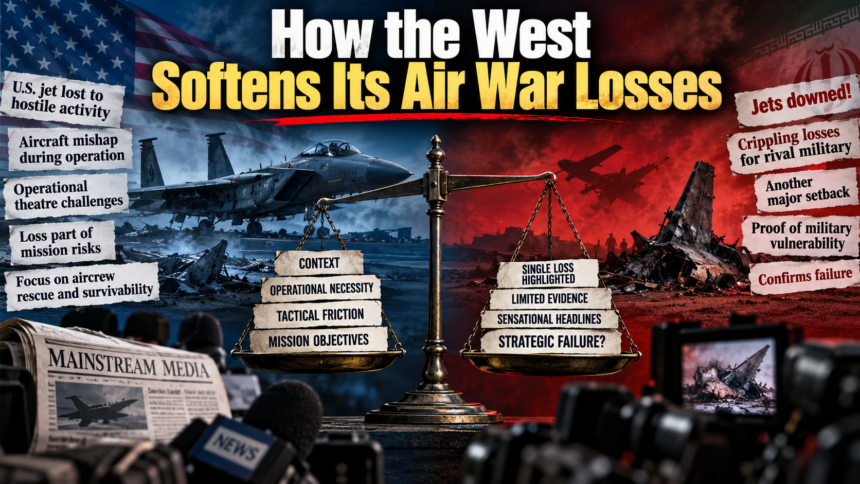
The United States military treats combat attrition as an inherent feature of high-intensity warfare. During operations involving Iran, Yemen and the Persian Gulf, American forces have suffered losses involving strike aircraft, transport platforms and unmanned surveillance systems. When acknowledged, such losses have generally been placed within the broader context of operational necessity, tactical friction and mission objectives.
The contrast becomes sharper in coverage of non-Western military operations, where individual equipment losses can dominate reporting even when the broader strategic outcome remains contested. The result, critics argue, is a form of selective framing in which Western losses receive extensive qualification while claims concerning rival militaries can be reported with substantially less evidentiary scrutiny.
One case cited is the loss of a U.S. Air Force F-15E Strike Eagle, call sign “Dude 44,” over Iran on April 2, 2026. According to the supplied account, the aircraft was conducting a night interdiction mission against missile and drone production facilities south of Isfahan when it was struck by an Iranian surface-to-air missile.
The incident was followed by a complex combat search-and-rescue operation. The aircraft’s weapons systems officer, identified by the call sign “Bravo,” survived the ejection despite severe injuries after the missile blast compromised his parachute. The account says he remained in mountainous terrain for about 50 hours while avoiding Iranian forces before being recovered.
The recovery operation itself involved a substantial American military presence. More than 90 U.S. personnel were reportedly inserted into Iranian territory, described in the source material as the first confirmed deployment of American ground combat troops inside Iran in 46 years.
The operation also resulted in the destruction of additional aircraft. Two C-130-class rescue transports became immobilised in soft desert terrain, according to the account, as hostile forces approached. Commanders subsequently ordered airstrikes to destroy the stranded aircraft and accompanying MH-6 Little Bird helicopters, preventing sensitive equipment from being captured.
Taken together, the incident represented a substantial episode of combat attrition. Yet the supplied material argues that Western coverage did not initially treat it primarily as a test of American air-superiority assumptions. Instead, the event remained largely out of mainstream reporting for several months before a CBS News segment on “60 Minutes” in September focused on the survival and rescue of the aircrew.
The same pattern is presented as extending beyond the Isfahan incident.
In the Red Sea theatre, American MQ-9 Reaper drones suffered repeated losses. The supplied material cites independent open-source trackers and official records as documenting between 17 and 25 destroyed Reapers, with each aircraft valued at about $30 million. Over one six-week period, U.S. Central Command confirmed the loss of seven front-line Reapers.
Naval aviation also experienced losses. An F/A-18E Super Hornet operating from the USS Harry S. Truman was lost overboard in rough seas, while another carrier aircraft was destroyed in a friendly-fire incident involving the cruiser USS Gettysburg. The material also cites the disappearance of high-altitude reconnaissance drones near the Strait of Hormuz, with some incidents categorised administratively as “Class-A mishaps.”
The argument is not that such losses should automatically be treated as evidence of strategic failure. Rather, it is that the same analytical standard should apply regardless of the military involved.
The supplied material points to a study of 1,240 defence articles that allegedly found Western news organisations required physical wreckage, serial numbers and Pentagon confirmation in more than 80% of reports involving American shootdowns, compared with an evidentiary threshold below 20% for non-Western forces. It also identifies a recurring difference in terminology, with losses involving Western aircraft described through comparatively neutral formulations such as aircraft being “lost to hostile activity” or suffering “equipment mishaps,” while reports involving non-Western forces more readily use direct formulations such as “jets downed” or “crippling losses.”
Access may also influence how defence stories are reported. Pentagon correspondents depend heavily on official briefings, background conversations and continuing access to military officials. The source material argues that aggressive reporting on systemic vulnerabilities can place those relationships at risk.
It also points to the commercial interests surrounding the defence industry, citing major aerospace companies including Lockheed Martin, Boeing and RTX. The argument is that the close relationship between defence journalism, government access and a powerful military-industrial sector can create incentives for coverage that avoids unnecessarily damaging narratives about Western military technology.
None of this changes the basic reality of warfare: aircraft and other military platforms can be lost even during successful operations. Counting equipment alone cannot establish whether a campaign achieved its objectives. Mission accomplishment, deterrence, operational effects and broader political-military outcomes can matter more than the number of aircraft destroyed.
That principle, however, has to be applied consistently.
If Western militaries are assessed according to mission objectives rather than an isolated tally of damaged or destroyed equipment, the same standard should be applied to non-Western militaries. Conversely, if individual losses are treated as evidence of operational failure in one case, comparable losses should not be minimised through softer terminology in another.
The central issue for international defence journalism is therefore less about defending or criticising any particular military than about maintaining a consistent evidentiary standard. Claims of battlefield losses require evidence. Strategic assessments require more than photographs of wreckage or competing casualty counts. And military operations should ultimately be examined through what they achieved, what they failed to achieve and what the available evidence establishes—not through an editorial accounting system that changes depending on whose aircraft are falling from the sky.

