



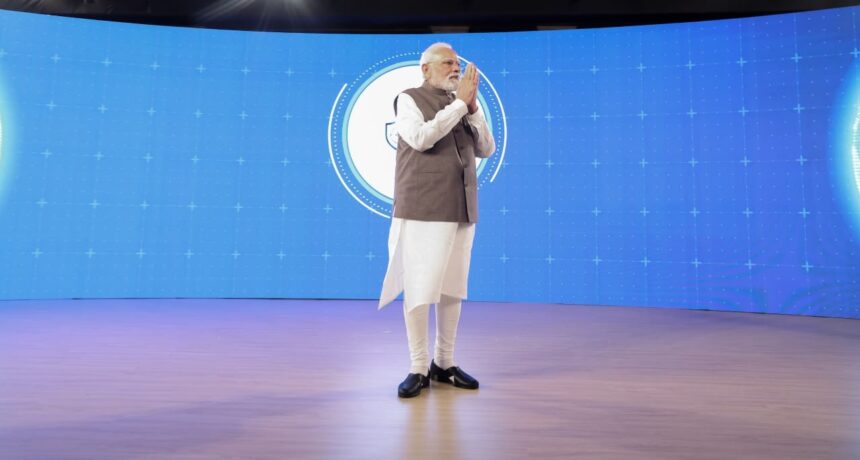
New Delhi: Prime Minister Narendra Modi said on Friday that India has political stability and continuity in its policies, and the world sees the country as a bright spot of growth and hope.
Addressing the Economic Times World Leaders Forum, Modi also said today, there are many concerns regarding growth and in these times, the world has witnessed a very severe form of weaponisation of resources.
“This atmosphere of distrust is bringing numerous new challenges for the world. Even in such times, the world is seeing India as a bright spot of growth and hope,” he said.
The prime minister said bringing reforms in all spheres is his government’s commitment and that India continues to take several steps to ensure continued growth momentum.
Modi asserted that India will further strengthen its position globally and he is committed to ensuring that.
“We are shaping pro-people, pro-growth policies. We have passed reform bills even during the last Parliament session marred by opposition protests,” he said.
The prime minister said India is undertaking next-generation reforms at the policy level, so that the country’s future is secure.
“It is reforming governance and ease of living. Reform is not a compulsion for us, it is our commitment, our conviction,” he said.
Modi promised that he will ensure that the “reform express” gains further speed.
“I promise more reforms for ease of living for our people,” he said.
Modi said the world has many concerns regarding growth as resources are getting weaponised, but India is being seen as a bright spot of growth.
He said the National Democratic Alliance (NDA) government has a clear roadmap for reforms, with a strong focus on governance.
“Our government is rewarding higher production with incentives,” he said.
Modi alleged that it was the policy of the previous regimes to keep people in scarcity, so that they beg before the government for even basic needs.
He said the licence raj of the previous governments used to add to the burden of unemployment, whereas the current government’s production-linked-incentive model is creating opportunities.
“We are not just changing regulations, we are changing the entire policy of regulations. Our government believes that there should be no regulation for doing something that has not been explicitly prohibited under a law,” he said.
“We are moving from the ‘prohibited-unless-permitted’ approach to the ‘permitted-unless-prohibited’ model,” the prime minister said.
He said India has moved away from the PLP (Production-Linked Punishment) model of the previous governments to PLIs (Production-Linked Incentives) now.
“Today’s young generation will be surprised to hear that there was a time in our country when if a company exceeded the fixed production limit, it would be punished. This was the PLP model of the previous licence-raj governments,” he said.
The prime minister said there have also been instances where if a factory produced more due to higher demand, it would receive a notice.
“Those who mock Make in India and Aatmanirbhar Bharat today are carrying forward the same mindset of their predecessors. A particular kind of distorted thinking was behind this approach,” he said.
Citing an example, the prime minister said earlier, no one could make India’s map without permission even though foreign satellites could map India, but his government has changed this system.
He also said the Bharatiya Janata Party-led government has decided that border infrastructure is India’s strength and not weakness.
“We have changed the picture of our border infrastructure,” Modi said.
The prime minister accused the previous governments of making announcements only for elections, while adding that headlines in politics have a life of just 24 hours.
“I would have made headlines by just promising free electricity, but I decided to provide free solar energy to every household,” he said.
Modi said over the last few years, the world has witnessed numerous ups and downs, and these experiences have made one thing clear — whether one likes it or not, the future of every country is connected with that of other countries.
“Nothing is possible in isolation, so this theme of this year’s summit, ‘Shared Future’, has become even more relevant. India has always moved forward with this very spirit,” he said, adding that during the country’s G20 presidency, the mantra was “One Earth, One Family, One Future”.
Modi said the International Monetary Fund’s (IMF) forecast suggests that India will remain the world’s fastest-growing major economy, while asserting that the country is taking steps that are giving momentum to its development.
The prime minister also referred to the crisis often engulfing the previous governments, alleging that certain people then always wanted a shortage of essential things and to keep the country’s citizens in deprivation.
They wanted the public to come before them with folded hands, he said.
Modi said earlier, the approach to regulation was “prohibited unless permitted”, but the current government is changing this approach to “permitted unless prohibited”.
“This means that if something is not legally prohibited, there is no need to seek permission at every step. The basic ideology is that the foundation of the relationship between the public and the government should not be suspicion, but trust,” he said.

