



NAVVNEET DUBEY
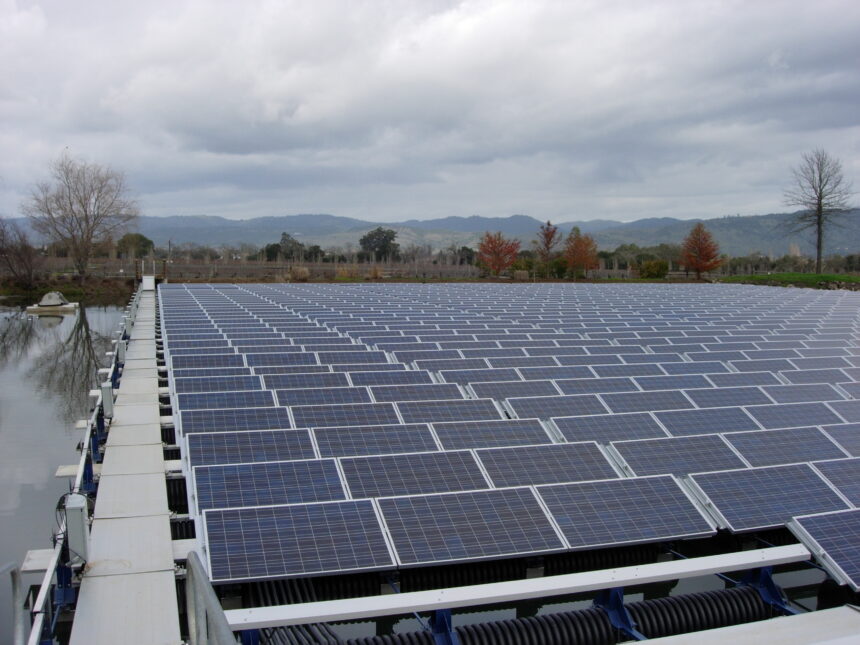
Jammu: Under the Pradhan Mantri Surya Sarovar Yojana (PM-SSY), the Jammu & Kashmir administration is promoting Floating Solar Photovoltaic (FSPV) projects across the Union Territory. Following the successful implementation of a 100 kW floating solar pilot project at Dal Lake, Srinagar, the Jammu and Kashmir Energy Development Agency (JAKEDA) has undertaken pre-feasibility surveys of potential water bodies to assess viability for larger installations.
Five reservoirs have been identified for development of floating solar projects, including two in Kashmir and three in Jammu, with an aggregate potential of 83.51 MW. Manasbal Lake in Ganderbal, with an identified potential of 34.06 MW, and Mansar Lake in Samba, with 31.9 MW, have been assessed as highly feasible sites for the first phase of development.
The roadmap was shared in meeting chaired by Chief Secretary Atal Dulloo. The meeting also reviewed the expansion of Small Hydro Power (SHP) projects under the Ministry of New and Renewable Energy guidelines for the period 2026-27 to 2030-31.
At present, seven small hydro projects with a combined capacity of 35.25 MW are operational, while another project of 3 MW is nearing completion. To fast-track capacity addition, Detailed Project Reports have been prepared for 76 projects up to 2 MW with an aggregate capacity of 118 MW, and for 56 projects in the 2-10 MW category with a cumulative capacity of 331 MW. These DPRs are expected to pave the way for expeditious tendering and implementation.Reviewing the implementation of PM Surya Ghar: Muft Bijli Yojana, the meeting noted that J&K has secured a significant share of the Model Solar Village component. Out of 15 Detailed Project Reports sanctioned by the Ministry of New and Renewable Energy across the country, eight DPRs have been approved for J&K, involving Central Financial Assistance of ₹7.99 crore.On wind energy, JAKEDA has undertaken systematic wind-resource assessment to address the historical data gap. Two primary wind masts installed at Bidda and Ijara have been successfully tested, with Bidda assessed as structurally feasible for development of a full-scale wind farm. JAKEDA also proposed installation of 5-10 kW vertical-axis wind turbines on a pilot basis at suitable locations and sought identification of an appropriate land bank for the purpose.
The framework aimed at accelerating renewable energy deployment while addressing the demand-supply timing gap and the need for grid-scale energy storage. targets development of 500 MW of ground-mounted solar, 150 MW of BESS and 50 MW of wind capacity by 2030, scaling up to 2,000 MW solar, 1,200 MW BESS and 300 MW wind capacity by 2040.The meeting also deliberated upon the proposed Compressed Bio-Gas (CBG) Policy, aimed at utilizing J&K’s substantial biomass and organic-waste resources for production of clean fuel. These CBG plants would utilize municipal wet waste, livestock manure, orchard waste and agricultural residue through anaerobic digestion to produce vehicle-grade compressed bio-gas. The process would also generate Fermented Organic Manure (FOM), providing an additional avenue for sustainable agricultural use and income generation.
The policy is aligned with the Government of India’s Special Assistance to States for Capital Investment (SASCI) 2026-27, with the potential to unlock financial assistance of up to Rs 50 crore under Component-I and Rs 55 crore under Component-II, subject to fulfilment of prescribed governance reforms. As per the proposed roadmap, J&K is targeting operationalization of at least six major CBG plants by March 31, 2030, with a combined production capacity of 32 tonnes per day (TPD) of clean fuel. The initiative is expected to generate more than 700 direct employment opportunities besides creating an ecosystem of local biomass and feedstock aggregators.

