



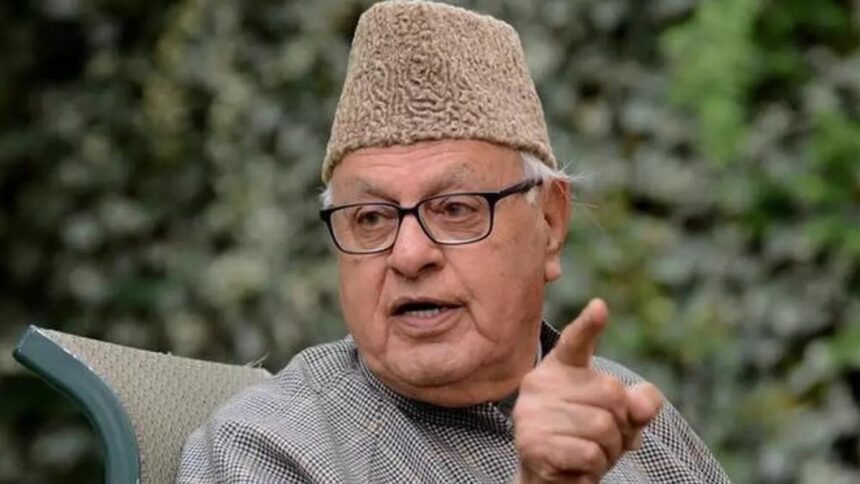
Srinagar: National Conference president Farooq Abdullah on Saturday called upon the Centre to open a new chapter in its relationship with Jammu and Kashmir, founded on mutual trust, democratic principles and constitutional guarantees.
He said the restoration of statehood to Jammu and Kashmir should serve as the essential first step.
In a statement, Abdullah called for a “decisive reset” in the New Delhi-Srinagar relations.
“The present government has an opportunity to take a historic step towards healing, reconciliation and rebuilding trust by honouring its commitment to restore statehood to Jammu and Kashmir. Restoration of statehood must be the beginning of a wider process of rights restoration, justice, dignity and mutual respect. The people of Jammu and Kashmir deserve nothing less,” he said.
Abdullah termed the events of August 9, 1953, particularly the “unconstitutional” arrest and ouster of then Prime Minister of Jammu and Kashmir Sheikh Mohammad Abdullah, “as a black day in the history of Jammu and Kashmir”.
“August 9, 1953 marked the beginning of a prolonged political and constitutional assault on Jammu and Kashmir’s distinctive constitutional position. Sheikh Mohammad Abdullah, a towering symbol of selfless nationalism and patriotism, chose incarceration over submission when confronted with attempts to undermine Jammu and Kashmir’s constitutional safeguards and install a pliant dispensation in Srinagar,” he said.
The National Conference chief said the “illegal and unconstitutional arrest” of a sitting prime minister inflicted a “deep and enduring wound” on the collective psyche of the people of Jammu and Kashmir.
“The political coup of 1953 shattered people’s faith in the democratic and constitutional assurances extended to Jammu and Kashmir and sowed the seeds of a profound trust deficit between Srinagar and New Delhi. That wound remains unhealed even today,” Abdullah said.
“Had this rupture not taken place, Jammu and Kashmir may well have been spared the prolonged political uncertainty, turmoil and immense human suffering that followed,” he added.
Abdullah said the National Conference remains steadfast in its commitment to safeguarding Jammu and Kashmir’s political, constitutional and cultural identity.
He said the events of 1953 fundamentally “altered” the relationship between the people of Jammu and Kashmir and the Union, creating a “trust deficit that successive developments only served to deepen”.
“Despite the sacrifices and sustained efforts made by the National Conference to bridge this divide, successive governments in New Delhi continued to approach Jammu and Kashmir predominantly through a security-centric prism, rather than addressing the political and constitutional aspirations of its people,” he added.

