



Leh: Union Home Minister Amit Shah on Friday said Ladakh was a model of rapid transformation since the 2019 bifurcation of the erstwhile state of Jammu and Kashmir, and listed sweeping political, social and economic changes in the Union territory.
The region has remained at the centre of Prime Minister Narendra Modi-led government’s development agenda, he said.
Shah said Ladakh had long demanded Union territory status due to lack of development and asserted that the decision had brought visible change across sectors.
His remarks came amid renewed calls by the Leh Apex Body and the Kargil Democratic Alliance (KDA) for resumption of talks with the Centre on statehood and inclusion under the Sixth Schedule.
“Ladakh had an old demand to be made a Union territory. The basic reason for this demand was that development was not taking place here. Now I want to tell you what has been done after it was made a Union Territory in 2019,” Shah said.
He said that Ladakh has now seven districts and 193 panchayats, with five new districts — Sham, Nubra, Changthang, Zanskar and Drass — created and notifications already issued.
Shah said that local languages had also been given administrative recognition. “Earlier only Hindi and English were in use, but now Bhoti, Purgi and Urdu have also been accorded importance”.
Highlighting infrastructure growth, he said road length in Ladakh has increased from about 1,799 km before 2019 to 4,040 km now. “The road constructions has almost doubled.”
The Centre bifurcated the erstwhile state of J-K into two Union territories – Jammu and Kashmir and Ladakh – on August 5, 2019, when it also abrogated Article 370 of the Constitution that gave special status to the erstwhile state.
Shah said that the number of bridges has risen from 19 to 72 increasing the number by three times.
Spelling out development in other sectors, he said that mobile towers have increased from 344 to 653, while helipads have gone up from seven to 41, he said. “Snow-clearing machines, crucial for the region, have increased from 60 to 215.”
On power infrastructure, Shah said grid-related works have increased from 145 to 184, while distribution transformers have gone up from 1,182 to 3,153.
“I am giving these figures on this scale because after becoming a Union Territory, it (Ladakh) has remained the focus of the Narendra Modi government, the focus of the prime minister of the country, and so many development works have taken place together,” the minister said.
He said the impact of better infrastructure was visible in road connectivity, with the Zojila Pass, which earlier remained shut for 127 days, remaining closed for only 19 days this year. “The Kargil-Leh road, which earlier remained closed for nearly 175 days, was shut for only 11 days.”
Shah said work on the Zojila tunnel is in progress, construction of the Shinkun La tunnel has started and a new civil airport is also coming up.
He said that VSAT connectivity has been extended to all panchayats and major work has been undertaken to upgrade telecom towers.
In the education sector, Shah said Sindhu Central University has been established, 174 ICT labs set up, 130 smart classrooms created, 40 science laboratories built and 24 Atal Tinkering Labs established.
He said Ladakh became a fully literate administrative unit in 2024 and claimed there was no illiterate person left in the region.
“Nearly 98 per cent households have been provided tap water connections under the Har Ghar Jal scheme, while substantial work has also been carried out in agriculture and horticulture,” he said.
Shah said Ladakh’s budget has risen from Rs 1,000 crore when it was part of the erstwhile Jammu and Kashmir state to Rs 6,000 crore now.
He also announced the formation of the Sindhu Infrastructure Development Corporation, saying it would play an important role in promoting industrial growth in the coming years. “We want this border region to become self-reliant,” Shah said.
He asserted that development in the UT is because of the vision of the prime minister.
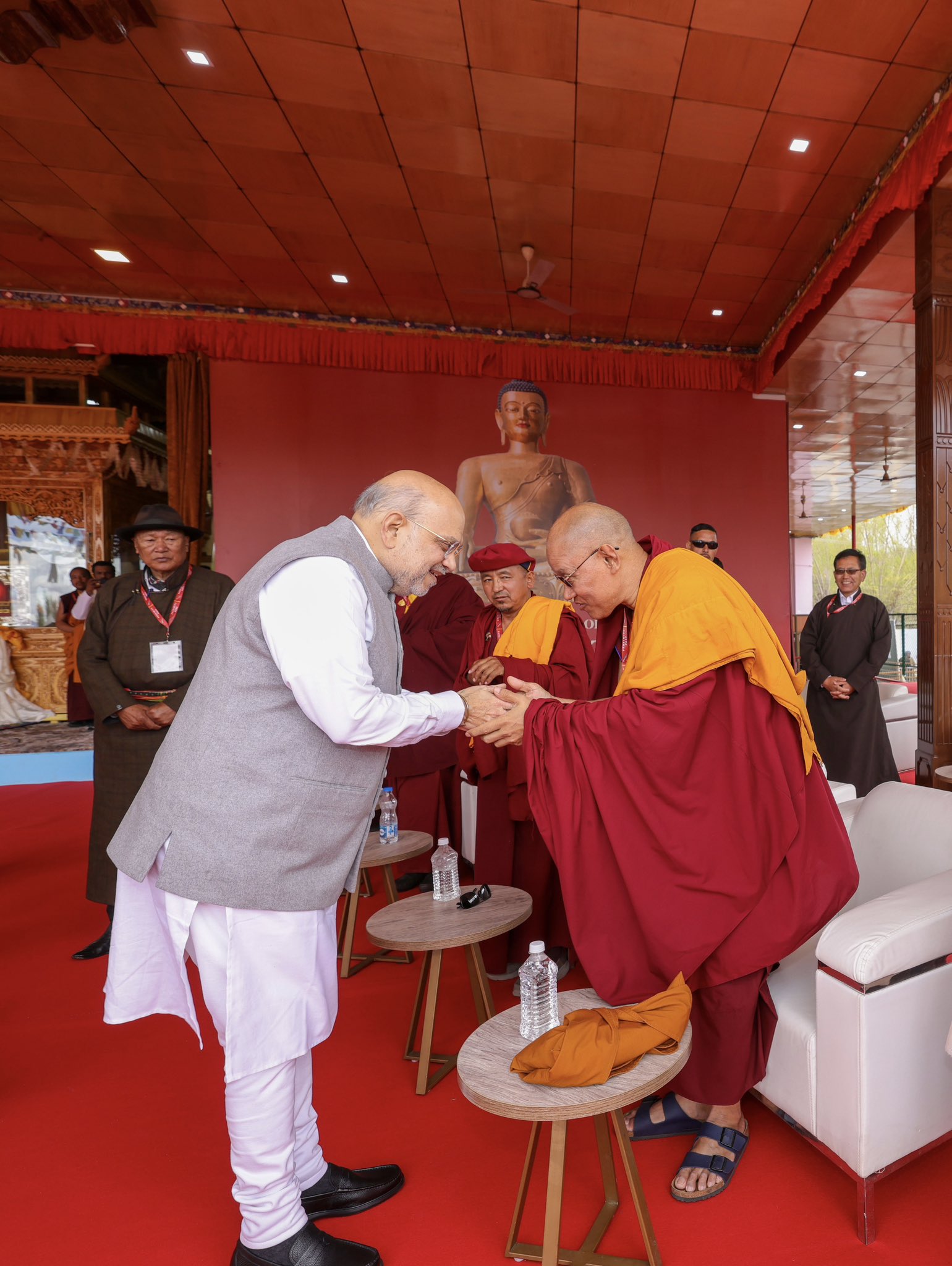
He also inaugurated a sacred holy relics exposition of Tathagata Buddha and the 2569th Buddha Purnima celebrations in Leh during his two-day visit to Ladakh.
The function was held at Jivetsal in the Photang-Choglamsar area of Leh town, officials said.
The revered Piprahwa relics of Tathagata Buddha — ancient sacred remains and associated objects linked to the lord discovered at Piprahwa, near the Nepal border in present-day Uttar Pradesh — arrived in Leh on Wednesday.
Shah inaugurated the exposition of the sacred relics by observing traditional religious rituals, the officials said.
In his address, Shah said this year, Buddha Purnima marked a historic and truly golden occasion for the residents of Ladakh.
He said on this auspicious occasion, the arrival of the sacred relics of Lord Buddha in Ladakh after 75 years will inspire the followers of Buddhism as well as others.
Much like in the life of Lord Buddha, it is rare for anyone to experience their birth, enlightenment and “Mahaparinirvana” occurring on the very same day, Shah said, adding that thus, the day is highly auspicious for everyone.
“The day has not only been marked by a religious event but also by a historic reunion. After so many years, Tathagata Buddha has returned to this sacred land, his most beloved land, which is a matter of great fortune,” he said.
The home minister said even today, wherever there is a Buddhist tradition across the world, the knowledge enriched from Ladakh is considered very important.
During the ceremony, Shah bowed reverently before the relics of Lord Buddha to pay his respects.
The “Mandala” offering was part of the rituals performed, the officials said.
The “Sumba” offering, considered among the highest forms of spiritual and material offerings, was also conducted.
The ritual includes offerings to the idol, religious scriptures and the stupa. The idol symbolises the body of Buddha and is dedicated to the long life of enlightened beings. The religious scriptures represent the preservation and dissemination of sacred teachings, symbolising the speech of Buddha. The stupa signifies purity and enlightenment, symbolising the mind of the lord, the officials said.
Following the completion of these offerings, the home minister proceeded to light the ceremonial lamp at the Buddha statue, marking the formal inauguration of the exposition.
The relics were brought from Delhi to Leh in a special Indian Air Force aircraft by Drukpa Thuksey Rinpoche and Khenpo ThinlasChosal of the Matho monastery.
The officials said the relics would remain available for public veneration at Jivetsal from May 2 to May 10, followed by an exposition in Zanskar on May 11 and May 12 and thereafter, at the Dharma Centre in Leh on May 13-14, before being flown back to Delhi on May 15.
Jivetsal has been designated as the main venue for the public exposition of the relics beginning Friday, which marks the 2569th Buddha Purnima celebrations.
Leh wore a festive look, with extensive beautification measures undertaken ahead of the occasion.
