



Arteev Sharma
Jammu: A fresh political debate has erupted in Jammu and Kashmir after the senior BJP leader and former minister Sham Lal Sharma publicly pitched for a separate state for the Jammu region, reviving a long-dormant but contentious discourse on statehood that dates back over two decades.
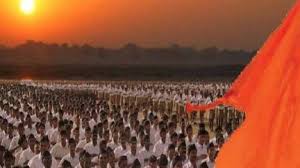
Sharma’s remarks have brought back into focus the Rashtriya Swayamsevak Sangh (RSS) resolution of 2002, which had formally advocated the trifurcation of the erstwhile state of Jammu and Kashmir.
The resolution, adopted on July 1, 2002, called for the division of the state into three distinct entities—Jammu, Kashmir and Ladakh—arguing that such a move would help address the vexed Kashmir issue, facilitate the rehabilitation of displaced Kashmiri Pandits and ensure adequate compensation for farmers in frontier areas affected by prolonged military deployment along the borders with Pakistan.
The demand had also led to the emergence of a political outfit, Jammu State Morcha (JSM) that vociferously advocated for the demand. JSM managed to win the Bishnah seat twice when its candidate Ashwani Kumar Sharma, who is currently in the BJP, won from the seat in 2002 and 2008.
While the demand had remained largely on the fringes of mainstream political discourse in recent years, the BJP leader’s latest statement has once again brought it to the centre of political debate in the Union Territory, triggering sharp reactions across party lines.
The demand for separate statehood for the Jammu region assumes significance as it has been raised at a time when political parties across the spectrum are demanding the restoration of full-fledged statehood to Jammu and Kashmir. Jammu and Kashmir was downgraded to a Union Territory following its bifurcation in 2019, when Ladakh was carved out as a separate Union Territory from the erstwhile state of Jammu and Kashmir.
Deputy Chief Minister Surinder Choudhary was quick to criticise the BJP leader, questioning both the timing and intent behind the statement. Taking a swipe at Sharma, Choudhary alleged that the former minister was attempting to “firm up his space within BJP circles” by raising a sensitive regional issue.
In a pointed attack, the Deputy Chief Minister indirectly underlined what he described as the economic interdependence between Jammu and Kashmir regions.
The Deputy Chief Minister said that Sharma appeared to have overlooked the economic consequences faced by Jammu following the discontinuation of the Darbar Move—a biannual practice under which the seat of governance used to shift between Jammu and Srinagar.
While highlighting Jammu’s “reliance” on economic linkages with Kashmir, Choudhary said the suspension of the Darbar Move had led to a “decline in trade and commercial activity” in Jammu.
Pertinently, this is not the first time when Sharma has taken such a position. In December 2010, when he was in the Congress party, he had made a similar statement advocating separate statehood for Jammu, a stance that had then stirred controversy.
What is interesting to see is that the BJP leadership has so far maintained silence on Sharma’s latest remarks. The absence of any official rebuttal or clarification from the party has fuelled speculation within political circles.
Insiders suggest that the BJP’s decision not to distance itself from the statement so far may indicate “tacit approval” or, at the very least, a willingness to allow the issue to resonate within certain political constituencies.

