



Hopes Amarnath Yatra pilgrims to cross 3.5 Lakh; Hails Shukla’s space mission
Jammu: Chief Minister Omar Abdullah on Wednesday said his government’s focus is to hand over a better and more empowered Jammu and Kashmir to the present generation, leaving behind the unfortunate Pahalgam terror attack that virtually crippled tourism sector in the Union Territory (UT).
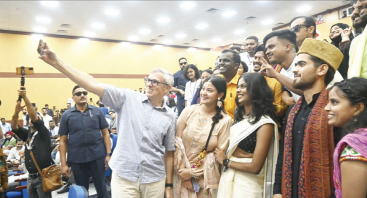
Abdullah was speaking at the valedictory function of Summer School: 2025 at the Indian Institute of Technology Jammu, marking the successful conclusion of a month-long programme that brought together over 1,000 students from across the nation.
Abdullah lauded IIT Jammu as a hub of talent and underscored the significance of such initiatives in providing young people, particularly from Jammu and Kashmir, with platforms to grow and realise their potential.
“Such programmes must encourage broad-based participation and give students from J&K the opportunity to turn their ideas into action,” the chief minister emphasised.
Abdullah revealed that his government is actively exploring collaborative opportunities with IIT Jammu across multiple domains, including water conservation, climate change adaptation, industrial growth and business incubation.
The backing of IIT lends credibility to any project, he observed, adding his government remains committed to fostering a venture funding framework that support innovation.
The chief minister welcomed the institute’s proposals on tourism interventions and green transport solutions, while encouraging students from outside the region to explore J-K and serve as its ambassadors.
Reflecting on recent challenges, Abdullah struck an optimistic note. “The unfortunate incident (in Pahalgam) earlier this year is behind us now. Our focus is to hand over a better, more empowered Jammu and Kashmir to this generation. May the future generations carve out opportunities through challenges,” he said.
The chief minister’s adviser, Nasir Aslam Wani, described IIT Jammu as a landmark institution of the region and stressed the need to enhance and expand sectors such as tourism and hospitality.
“Tourism is our unique strength and we must continue to build on it through innovation, training and infrastructure,” Wani said.
The initiative, organised under IIT Jammu’s innovation ecosystem, witnessed remarkable participation from students representing more than 25 states and UTs.
In a significant indicator of the region’s growing aspirations for technical skills, nearly one-third of the participants — 319 students — came from J-K itself.
Students from diverse backgrounds converged at the campus, including representatives from Delhi, Punjab, Karnataka, Bihar, Kerala, Tamil Nadu, Manipur and several northeastern and eastern states, a spokesperson of the IIT said.
He said the programme offered structured learning modules in cutting-edge technologies, including Artificial Intelligence, Cybersecurity, Full Stack Web Development, Internet of Things (IoT), Data Science and Additive Manufacturing.
Each module comprised over 40 hours of intensive instructions, combining theoretical lectures with hands-on training, industry interactions and feedback-driven mentoring sessions.
The programme brought together faculty, researchers and education partners, including alumni-led startups, who contributed significantly to the initiative’s delivery, the spokesperson said.
He also hailed the successful mission of astronaut Shubanshu Shukla aboard the International Space Station and said this is a step in the direction of hoisting the national flag on the Moon.
Abdullah also expressed satisfaction at the cave shrine of Amarnath in south Kashmir Himalayas registering a footfall of over 2.50 lakh since the beginning of the 38-day yatra on July 3, and said it was unimaginable in the aftermath of the Pahalgam attack. The April 22 attack left 25 tourists and a local pony service provider dead.
“It is good that he (Shukla) returned safe and sound. Earlier, our astronauts had gone on a space mission with Russian teams, but this time he went there aboard the International Space Station.
“The government of India had a mission to send humans to the Moon on our own, and this is a step in that direction. I hope the time will come when the country’s flag will be hoisted on the Moon,” the chief minister told reporters on the sidelines of a function here.
Talking about the ongoing Amarnath Yatra, Abdullah expressed hope that the number of pilgrims would cross 3.5 lakh this year.
“There was a time when we were sceptical about anyone coming for the yatra this time due to the Pahalgam incident. So far, 2.50 lakh people have visited, and if this trend continues, the number will easily cross the 3.50 lakh as the yatra will continue till August 9… I hope the number will increase further,” he said.
On the controversy surrounding his government’s decision to make Urdu mandatory for the Naib Tehsildar recruitment examination, the chief minister defended the move, saying, “We do not have any wrong intention to keep anyone outside.”
“You have to keep in mind that our revenue records, even before independence, were in Urdu, so we will not deploy staff who cannot read Urdu. What work will they do?” he said.
The chief minister said earlier, IAS and JKAS officers with no knowledge of Urdu were given six months to one year to acquire basic knowledge of the language.
“So, it will be better if there is some policy to give the Revenue Department staff time so that they can achieve some sort of proficiency in Urdu otherwise, they cannot read the revenue records,” he said.

