



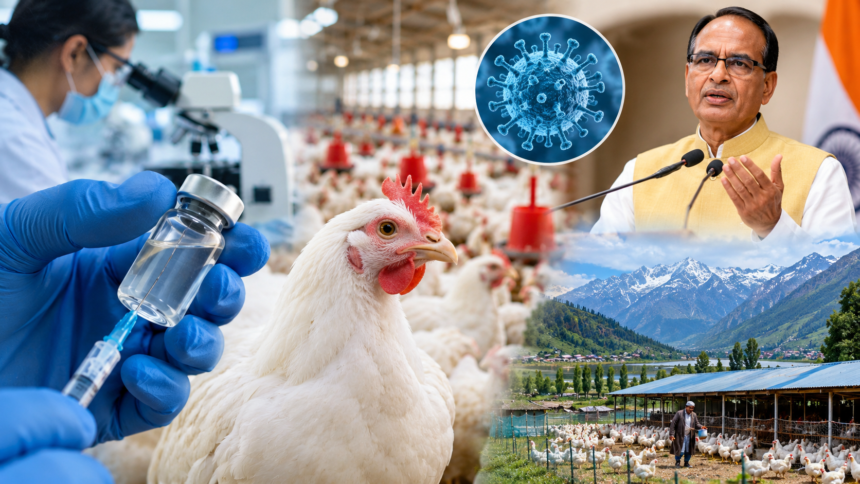
JAMMU, November 18: India has developed its first indigenous vaccine to protect poultry from bird flu. Union Agriculture and Farmers Welfare Minister Shivraj Singh Chouhan will dedicate the vaccine to the nation on November 20 in Bhopal.
The vaccine has been developed to protect chickens against the H5N1 virus. It has been developed by the ICAR-National Institute of High Security Animal Diseases (NIHSAD), based in Bhopal.
According to the Ministry of Agriculture, this is the first indigenous vaccine of its kind and is expected to help protect poultry from the highly dangerous bird flu disease.
The ministry said bird flu is a serious disease that affects chickens and other birds. Outbreaks can cause a very high death rate among infected birds, leading to heavy financial losses for poultry farmers. It also affects the trade of poultry and poultry products.
According to the ministry, bird flu was first detected in India in 2006. Since then, more than 500 outbreaks involving the H5N1 and H5N8 virus subtypes have been reported across the country.
The central government has warned that a major bird flu outbreak could reduce India’s GDP growth rate by up to 1.5 per cent. There is also a risk that more than 20 per cent of the country’s poultry population could be affected and require culling.
The bird flu outbreak in 2006 caused direct and indirect losses of approximately Rs 2,200 crore to Rs 3,000 crore in India. Manipur also suffered losses equivalent to 0.5 per cent of its state GDP due to the outbreak.
Important Development for Jammu and Kashmir’s Poultry Sector
The new indigenous vaccine could also prove beneficial for the poultry sector in Jammu and Kashmir. Poultry farmers and businesses across the Kashmir Valley and Jammu region face the risk of financial losses in the event of bird flu outbreaks.
The availability of an indigenous vaccine could help strengthen disease prevention and provide better protection to the poultry sector in the Union Territory.
Bird flu is also a concern for human health, apart from its impact on birds. According to the World Health Organization (WHO), since 2003, a total of 1,003 human cases of H5N1 avian influenza have been reported across 25 countries, including India, resulting in 479 deaths.

