



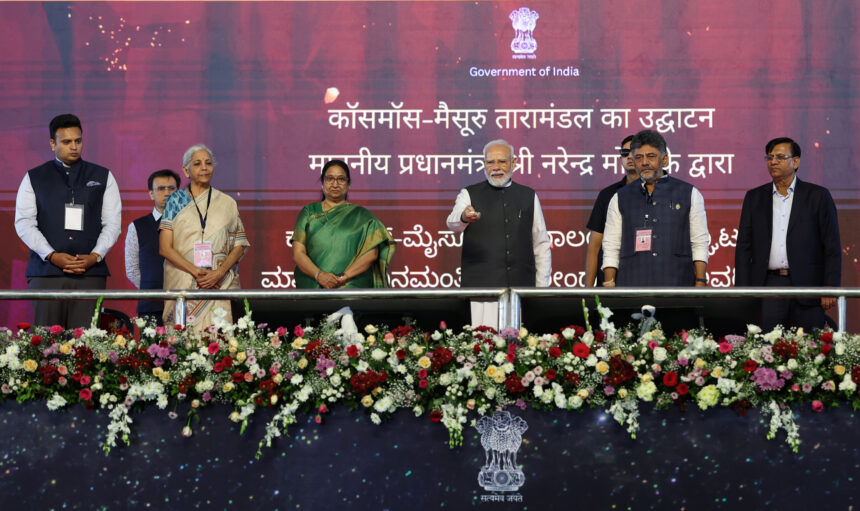
Bengaluru: Prime Minister Narendra Modi on Friday said the measures taken over the past decade to strengthen India’s energy security had helped the country face challenges arising from the ongoing conflict in the Middle East with confidence, and detailed the strides made in the energy sector over the years.
At back-to-back events in Bengaluru and Mysuru, the PM inaugurated and laid the foundation stone for development projects worth over Rs 15,600 crore across Karnataka, in sectors including railway and energy. He also touched upon the advancements made in the space sector.
The initiatives launched by him include the Pink Line of Namma Metro in Bengaluru, with the PM travelling on the newly launched service with Karnataka Chief Minister D K Shivakumar after jointly flagging it off with the latter.
Besides, he flagged off a Vande Bharat train service, dedicated India’s first LED dome planetarium in Mysuru to the nation and addressed the Golden Jubilee celebrations of Prashanti Kutiram, a Yoga and research centre run by S-VYASA, where he traced the global recognition Yoga has achieved over the past decade due to the country’s efforts to popularise it.
Modi inaugurated four redeveloped railway stations of Chamarajanagar, Chikkamagaluru, Sakleshpur and Subrahmanya Road in the state under the Amrit Bharat station scheme. He also dedicated to the nation the 45 km Bagalkot-Wandal railway line doubling section, forming part of the 284 km Gadag-Hospet Doubling Project.
Addressing a gathering in Bengaluru, Modi said the armed conflict in and around Iran and the Gulf region had demonstrated the importance of energy security.
“This has also been a challenging period for India. However, the steps taken over the past decade to strengthen energy security have helped us face this crisis with confidence,” he said.
The measures included increasing domestic production capacity of petrol, diesel and LPG, developing crude oil storage facilities, expanding renewable energy, achieving nearly 100 per cent railway electrification and strengthening public transport.
Among the projects inaugurated was an LPG storage facility in Mangaluru, which will increase the country’s storage capacity by 80,000 metric tonnes.
The Devangonthi Marketing Terminal in Bengaluru will strengthen supplies of petrol, diesel and aviation fuel, while a compressed biogas plant will produce around 13 tonne daily.
India’s renewable energy capacity had crossed 300 GW, the PM said. Over 60 lakh families had installed rooftop solar plants under the PM Surya Ghar Muft Bijli Yojana. Karnataka has 40,000 beneficiaries.
More than eight lakh solar pumps were also providing irrigation facilities to farmers in the state under PM-KUSUM, he said.
Modi inaugurated renewable energy transmission projects in Koppal, Gadag and Bidar worth around Rs 5,820 crore and laid foundation stones for projects in Davanagere, Chitradurga and Ballari costing over Rs 4,550 crore.
He inaugurated the 7.5-km elevated section of the Namma Metro Pink Line between Kalena Agrahara and Tavarekere, built at a cost of around Rs 3,470 crore, and travelled on the train with Shivakumar, Governor Sudha Yadav and others.
The 21.25-km Pink Line comprises 18 stations, including six elevated and 12 underground stations. The underground section is still under construction, while the newly inaugurated stretch will open to the public from 6 am on November 14.

