



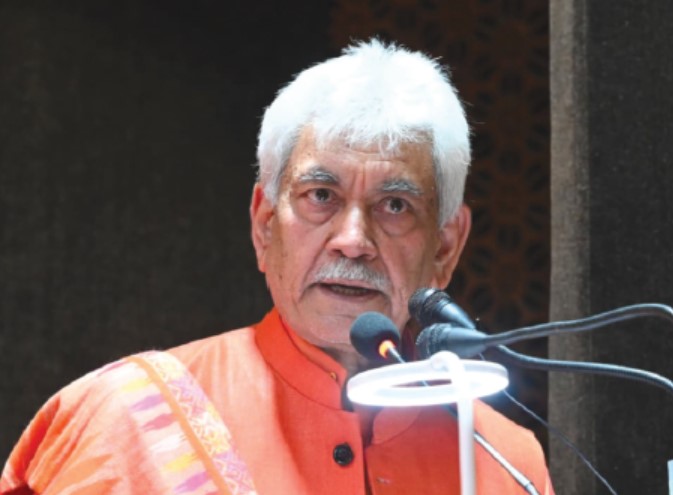
Srinagar: Lieutenant Governor Manoj Sinha on Tuesday said the abrogation of Articles 370 and 35A in August 2019 fulfilled Sardar Vallabhbhai Patel’s “unfinished dream” for Jammu Kashmir, describing the constitutional change as a significant step towards the region’s psychological and emotional integration.
Sinha made the remarks while launching the book Sardar Patel and Kashmir: The Untold History. He paid homage to Sardar Patel’s foresight and nation-building vision and described him as the “architect of modern India”.
The Lieutenant Governor said Patel’s vision of “Ek Bharat, Shreshtha Bharat” continued to inspire the country as it worked towards peace, development and empowerment.
Sinha said Patel’s indomitable will and practical wisdom ensured the integration of 562 princely states into a united country. He recalled Patel’s firm stance on Jammu Kashmir, noting his declaration that “we will not give even an inch of Jammu Kashmir’s territory to anyone.”
“Through his indomitable willpower, clear vision, selfless diligence, and skilful organisational strength, he ensured that the dream of an undivided India became a reality. I also believe that had Sardar Patel been given the responsibility for Jammu Kashmir, perhaps the problems that the people here endured for more than six decades would not have arisen,” he said.
Sinha described the book as a serious attempt to re-evaluate history with honesty and impartiality. He said historical narratives had for too long been shaped by ideological biases that overlooked the contributions of leaders such as Sardar Patel.
He urged the new generation of writers to treat history as a mirror of truth rather than a tool for glorification, and to learn from past decisions to guide the future.
The Lieutenant Governor described the abrogation of Articles 370 and 35A in August 2019 as the fulfilment of Sardar Patel’s unfinished dream. He said the constitutional change was not merely legal but a profound step towards psychological and emotional integration, ensuring equal rights and opportunities for all communities in Jammu Kashmir.
“In August 2019, under the leadership of Hon’ble Prime Minister Shri Narendra Modi, the nation witnessed a historic constitutional change. New possibilities of education, employment, entrepreneurship and development opened up for the youth.
“The Hon’ble Prime Minister’s decision proved that when national interest becomes the supreme priority, no obstacle remains permanent. This is the same firm willpower whose glimpse we saw in Sardar Patel’s nation-building efforts in 1947. I believe that by consigning the era of Article 370 to history, Jammu Kashmir now stands at the threshold of a new future,” he said.
Sinha outlined four priorities for Jammu Kashmir’s future—peace through zero tolerance towards terrorism, rapid development through infrastructure and connectivity, empowerment of youth by linking them to India’s digital economy and startup culture, and revival of cultural heritage to strengthen tourism and human values.
He said the most valuable asset of Jammu Kashmir was its talented youth and their energy must continue to be transformed into nation-building.
The Lieutenant Governor envisioned Srinagar, Jammu and other cities of the Union Territory as vibrant centres of education, trade and innovation.
He described the book as a “lighthouse” illuminating Sardar Patel’s dream of a united and confident India and called upon citizens to dedicate themselves to the ideals of unity, integrity and patriotism.
Sinha also expressed gratitude to Bhagwan Shri Swaminarayan Ji and commended the Maninagar Shree Swaminarayan Gadi Sansthan for its contributions to spiritual upliftment, education and humanitarian service. He congratulated Dr Rizwan Kadri for editing and publishing the book.
Acharya Shree Jitendriyapriyadasji Swamiji Maharaj, Kishor Makwana, Chairperson, National Commission for Scheduled Castes, Dr Rizwan Kadri, Swami Bhagwat Priya Das Ji, Brij Mohan Sharma, Principal Secretary, Culture Department, senior officials, prominent literary personalities and office bearers of Maninagar Shree Swaminarayan Gadi Sansthan attended the book launch ceremony.
Meanwhile, LG urged students to embrace lifelong learning, creativity, empathy and values in the age of artificial intelligence.
He made the remarks while inaugurating new facilities at the University of Jammu, including a sports complex, shooting range, and guest house, among others.
“In the age of AI, I urged students to embrace lifelong learning, creativity, empathy and values. Technology must remain humanity’s servant, never its master,” the Lt Governor said in a post on X
Talking about the new additions at the university, he said, “I believe these will empower students in sports, scholarship and strengthen the university’s hospitality.”
‘Millets can become people’s movement’
Srinagar: Lieutenant Governor Manoj Sinha on Tuesday said millets could play an important role in addressing malnutrition, tackling lifestyle-related diseases and improving the prosperity of marginal farmers, while calling for a complete ecosystem to promote their cultivation, processing and consumption in Jammu Kashmir.
Sinha made the remarks while addressing the concluding session of the Millets Mission programme at Lok Bhavan, Srinagar. The event, organised in collaboration with Kheti Virasat Mission, brought together farmers, scientists, chefs, doctors, students and policymakers from across the country for discussions on the revival and promotion of millets.
Congratulating the participating institutions for creating a platform highlighting the nutritional, ecological and economic significance of millets, the Lieutenant Governor said varieties such as jowar, bajra, ragi, kodo, kangni and kutki had nourished human civilisation for centuries.
He said bringing millets back into daily diets was both a health imperative and a civilisational responsibility.
The Lieutenant Governor noted increasing soil degradation, water stress and loss of biodiversity and said millets offered an opportunity to address these challenges.
“Several research studies show that millets require minimal water, thrive on rain-fed lands, need little or no chemical inputs and they are highly nutritious, rich in fibre, iron, calcium and protein, with a low glycaemic index that helps combat lifestyle diseases such as diabetes,” he said.
Highlighting the potential of millets in Jammu Kashmir, Sinha identified three key benefits—addressing malnutrition, providing solutions to lifestyle-related diseases and ensuring prosperity for marginal farmers.
He called for the creation of a complete ecosystem covering seed diversity, farmer training, processing, value addition, chef training and millet-based cuisine campaigns to make millets a people’s movement.
“All stakeholders should focus on seeds and crop diversification so that we can revive the diversity of our rich agricultural heritage. Now, we must move beyond seminars to the field and the market. Initiatives such as processing, value addition, chef training, ‘from grain to plate’ programmes, and women’s home-based millet-cuisine campaigns must be transformed into a people’s movement, only then will we achieve success,” he said.
Sinha stressed that millets were climate-smart crops that could offer resilience against increasing weather uncertainties and changing monsoon patterns.
He underlined the importance of a sustainable food system for public health, workforce productivity and environmental conservation.
The Lieutenant Governor also urged officials, experts and the media to continuously promote millets as part of everyday life and language.
He said farmers’ prosperity and conservation of nature could go hand in hand, describing millets as a pathway towards sustainable, inclusive and future-ready agriculture in Jammu Kashmir.
“Over the past two days, farmers, scientists, chefs, doctors, students and policymakers came together to reimagine a sustainable food system,” Sinha said.
He added that Jammu Kashmir could lead the way in making millets a people’s movement, strengthening farmers, empowering women and youth entrepreneurs and ensuring healthier lives for all.
Following the event, a millet-based dinner was served, showcasing the diversity, taste and health benefits of the traditional grains.
