



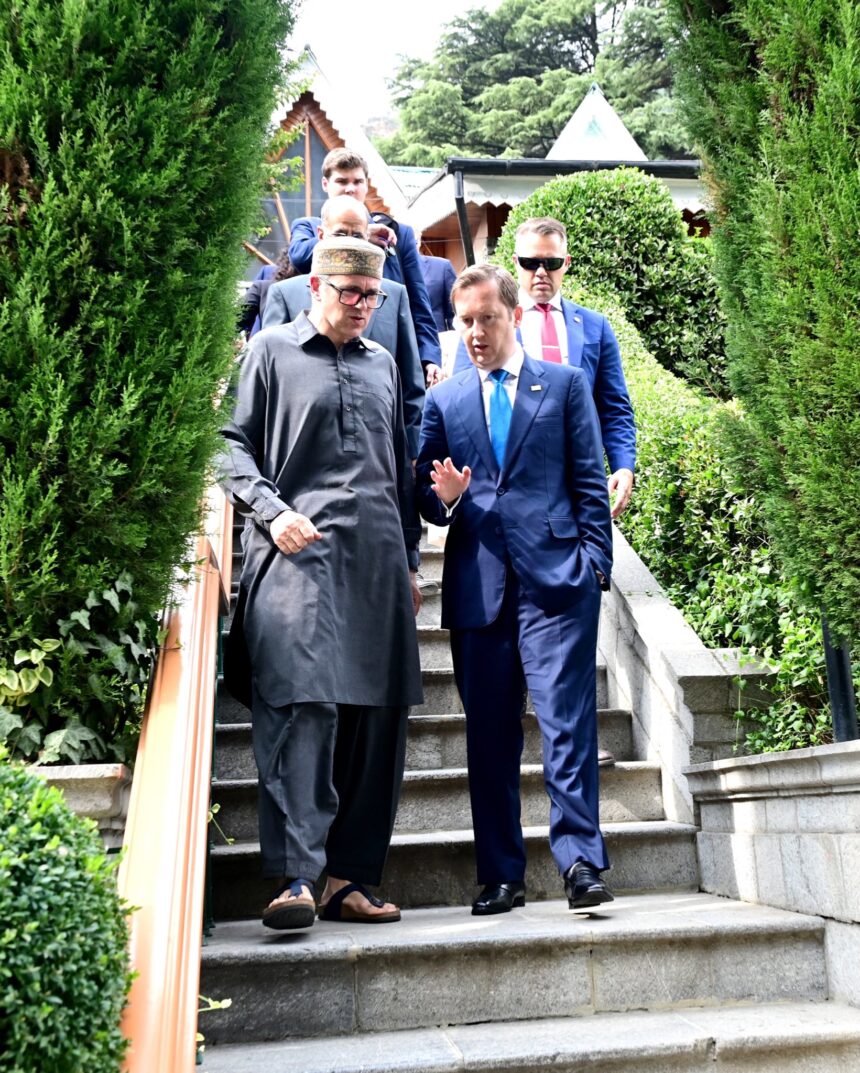
US Ambassador Sergio Gor’s remarks on Jammu and Kashmir, and Washington’s willingness to review its travel advisory, signal a shift from conflict-driven perceptions towards normalcy, tourism and international confidence.
By Bharat Nanda
US Ambassador to India Sergio Gor’s visit to Jammu and Kashmir may, at first glance, appear to be another diplomatic engagement in a region that routinely attracts international attention. But his statement that Jammu and Kashmir is “an important part of India”, coupled with his indication that the United States will review its travel advisory for the region, gives the visit a significance that extends well beyond protocol.
For India, the message is reassuring. For Jammu and Kashmir, it is potentially consequential. For Pakistan, however, it is uncomfortable.
The reason is simple. For decades, Pakistan has worked consistently to project Jammu and Kashmir internationally as a permanently disputed, unstable and conflict-ridden territory. That narrative has been central to Islamabad’s diplomatic outreach, its statements at international forums and its attempts to internationalise the issue.
Yet diplomatic narratives survive only as long as they remain compatible with changing realities.
What Sergio Gor’s visit appears to indicate is that the international conversation around Jammu and Kashmir may gradually be shifting from conflict and instability towards normalcy, tourism, economic activity and engagement.
That is precisely the shift Pakistan has historically sought to prevent.
The importance of Gor’s statement lies as much in its location as in its wording. He was not speaking about Jammu and Kashmir from Washington or New Delhi. He was visiting the region itself, meeting elected representatives, interacting with local stakeholders and witnessing a place that India increasingly wants the world to see through the prism of tourism, development and everyday life.
When the American Ambassador describes Jammu and Kashmir as an important part of India while standing in the region, the diplomatic symbolism is difficult to overlook.
Pakistan’s discomfort with such statements is understandable from the perspective of its long-standing position. Islamabad continues to describe Jammu and Kashmir as disputed territory and has repeatedly rejected any international language it believes weakens that claim.
But the larger challenge for Pakistan is no longer just diplomatic terminology.
It is the changing image of Jammu and Kashmir.
For years, international perceptions of Kashmir were shaped overwhelmingly by terrorism, street violence, separatist politics and military confrontation. Foreign travel advisories reflected that reality. Many governments discouraged their citizens from visiting. International media coverage was disproportionately focused on security incidents.
That image created an environment in which Pakistan’s narrative found greater resonance.
Today, however, that picture is more complicated.
Tourists continue to arrive in large numbers. Hotels, houseboats, transport operators, restaurants and local businesses depend increasingly on a functioning tourism economy. Srinagar, Gulmarg, Pahalgam and Sonamarg are once again being promoted as destinations rather than merely locations associated with conflict.
This does not mean that the security challenge has vanished. Terrorism continues to pose a threat, as recent attacks have tragically demonstrated. Pakistan-based terrorist organisations and cross-border networks remain a serious concern for India.
But there is an important distinction between the continued existence of a security threat and the ability of that threat to define an entire society.
That distinction is becoming increasingly important in Jammu and Kashmir.
The strongest answer to terrorism is not merely the elimination of terrorists. It is also ensuring that terrorism fails to determine how ordinary people live.
When markets remain open, tourists continue arriving, young people build businesses, schools function, infrastructure expands and political institutions operate, the strategic objective of terrorism is weakened.
This is where the proposed review of the American travel advisory assumes wider importance.
The United States currently maintains a highly restrictive travel advisory for Jammu and Kashmir. Such advisories are not merely notices for tourists. They influence insurance companies, international travel operators, corporate risk assessments, universities and other governments.
If Washington eventually concludes, after its own assessment, that the advisory can be relaxed, the consequences could be significant.
It would indicate that the security situation in Jammu and Kashmir is being evaluated on the basis of present conditions rather than historical assumptions.
For Pakistan, such a development would represent a diplomatic setback not because America would suddenly abandon its broader regional interests, but because one of Islamabad’s most persistent international arguments would become harder to sustain.
Pakistan’s diplomatic strategy on Kashmir has traditionally depended on convincing the world that the region remains fundamentally unstable and that international intervention is therefore necessary.
But what happens when foreign governments begin travelling to Kashmir themselves?
What happens when ambassadors speak about tourism instead of conflict?
What happens when travel advisories begin to change?
What happens when foreign visitors increasingly experience Srinagar, Gulmarg and Pahalgam as tourism destinations rather than security zones?
At that point, the narrative begins to change through experience rather than argument.
This is why tourism has a strategic dimension that is often underestimated.
A foreign tourist visiting Kashmir is not merely contributing to the local economy. He or she is also forming an independent impression of the region.
A traveller who stays on a houseboat, walks along the Boulevard, visits Gulmarg, speaks with shopkeepers and travels through the countryside returns home with an understanding of Kashmir that cannot easily be shaped by political messaging from either India or Pakistan.
That experience becomes its own form of diplomacy.
For Pakistan, this presents a fundamental challenge.
The more normal Jammu and Kashmir appears to the outside world, the harder it becomes to sustain an international narrative based almost exclusively on crisis.
This perhaps explains why statements such as Gor’s attract such strong reactions from Islamabad.
But India should resist the temptation to interpret every diplomatic development merely as a victory over Pakistan.
The more important objective should be to make the transformation of Jammu and Kashmir sufficiently durable that international perceptions change naturally.
Travel advisories should change because the security environment genuinely improves.
Tourists should visit because they feel safe.
Investors should engage because they see opportunity.
Diplomats should travel because visiting Jammu and Kashmir becomes routine.
That is a far more powerful outcome than any rhetorical exchange between New Delhi and Islamabad.
There is also a broader strategic lesson here.
For decades, Pakistan attempted to keep Kashmir internationalised by ensuring that conflict remained central to its global image. Terrorism, infiltration and political instability ensured that every serious incident revived international attention.
India’s long-term response therefore has to be the opposite.
Normalcy must become irreversible.
The more ordinary Jammu and Kashmir becomes, the less space there is for extraordinary external intervention.
A functioning economy, growing tourism, democratic participation, infrastructure development and improved security together create something that diplomatic arguments alone cannot produce: credibility.
Sergio Gor’s visit is important precisely because it suggests that this credibility is increasingly being noticed.
His reference to Jammu and Kashmir as an important part of India will undoubtedly receive the greatest political attention. But his willingness to consider reviewing the American travel advisory may ultimately prove more consequential for ordinary people.
If that review results in a less restrictive assessment, it could encourage greater foreign tourism and gradually influence perceptions in other countries as well.
For Kashmir’s tourism sector, this would provide confidence.
For India, it would strengthen the argument that the region should be judged by contemporary realities.
For Pakistan, it would pose an uncomfortable question.
If the world increasingly sees Jammu and Kashmir as a place to visit rather than a conflict to mediate, what happens to a diplomatic narrative built around permanent instability?
Perhaps that is the real significance of Sergio Gor’s visit.
The most important change in Kashmir may not be that the world is suddenly taking India’s word for what is happening there.
It may be that more of the world is beginning to come and see for itself.
The author is a technology professional, geopolitical analyst, newspaper columnist and author based in Jammu. He can be reached on [email protected] and x.com/bharatnanada_

