



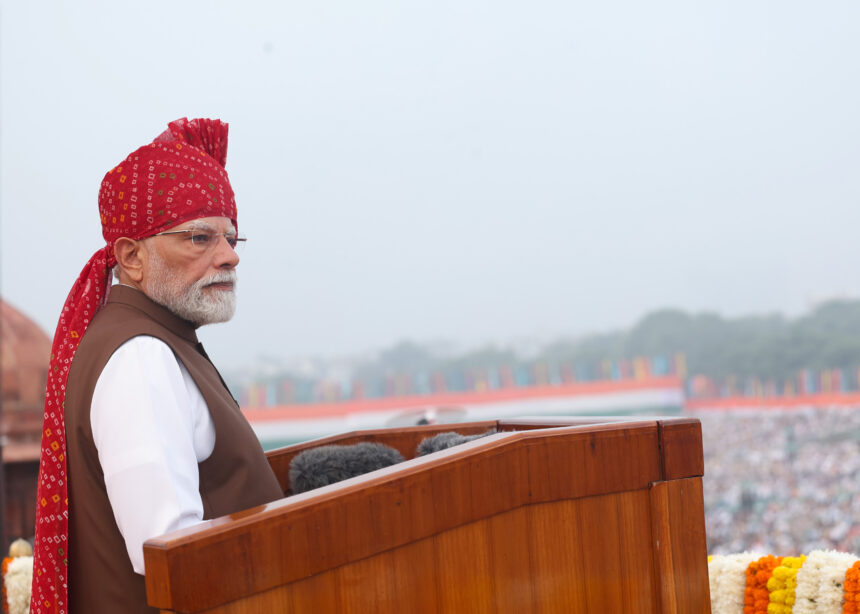
NEW DELHI: Prime Minister Narendra Modi laid out an ambitious roadmap for transforming India into a developed nation by 2047, during his Independence Day address from the Red Fort to pitch a combination of defence self-reliance, technological advancement, energy security, manufacturing expansion, youth empowerment and social development as the foundations of Viksit Bharat.
Addressing the nation on the 80th Independence Day, Modi said India must move beyond small ambitions and develop capabilities matching the country’s aspirations. He said a nation achieves greatness when it advances on the strength of its dreams, resolutions and capabilities.
“With the hard work of 140 crore countrymen, we will definitely make a Viksit Bharat by the 100th year of independence,” the Prime Minister said, setting 2047 as the deadline for the country’s transformation into a developed nation.
At the outset, Modi paid tribute to freedom fighters and revolutionaries and greeted citizens on Independence Day, while also expressing solidarity with families affected by recent floods and landslides. He assured those affected that the entire country stood with them in their hour of crisis.
A major highlight of the address was the unveiling of the ‘Saptdhara’ or seven-stream strategy, which Modi described as a framework for giving India a new speed and direction.
The seven streams are manufacturing; agriculture and food processing; technology and innovation; Gati Shakti; Defence Shakti; green and blue economy; and soft power.
Under manufacturing, Modi called for India to build complete domestic value chains, from design and components to finished products, while maintaining zero-defect standards, competitive costs and global quality.
He said India must emerge as a reliable centre of global supply chains and urged domestic companies to produce goods that are better and cheaper than products available from international markets.
The Prime Minister also set ambitious corporate targets, including having 50 Indian companies in the Fortune 500, besides building globally competitive institutions in banking, pharmaceuticals, law, rating, consulting, accounting and technology.
Defence self-reliance emerged as one of the strongest themes of the speech, with Modi placing ‘Raksha Shakti’ among the seven pillars of the Viksit Bharat strategy.
He called for India to become a major global supplier of defence technology rather than merely a large defence market. Drones, counter-drone systems and hypersonic technologies, he said, would be among the areas in which India must build capabilities and compete globally.
The Prime Minister also highlighted the growth in defence production and said India’s defence exports had increased dramatically, with Indian defence products now reaching around 100 countries.
Recognising the changing nature of warfare and the vulnerability of civilian infrastructure, Modi announced the creation of a modern, voluntary Civil Defence network.
He said cyber security would also form an important component of national defence, with India’s young digital workforce being harnessed to protect the country’s digital borders and contribute to global cyber security.
Technology and innovation formed another major pillar of the Prime Minister’s 2047 vision.
Modi said India must not remain merely a global market for advanced technologies but should become a global innovation hub in artificial intelligence, quantum computing, space, advanced robotics, Digital Public Infrastructure and 6G.
In one of the biggest announcements aimed at young Indians, he said the government would work to train one crore youth in AI skills within the coming year, enabling India’s young workforce to take leadership positions in the rapidly expanding AI economy.
The Prime Minister also announced a free online coaching network for competitive examinations, aimed at reducing the financial and emotional burden of exam preparation on middle-class families by bringing top teachers and digital resources within the reach of students.
On semiconductors, Modi said three domestic plants were already operational and exporting chips to global markets. He announced that seven to eight more semiconductor production facilities are expected to become operational within one to two years, strengthening India’s technological self-reliance.
He also highlighted the growth of India’s startup ecosystem, saying the country now has around 2.5 lakh registered startups, while the Rs 1 lakh crore Research and Innovation Fund, Skill India, Khelo India, private participation in space and other initiatives were creating new opportunities for young people.
Modi announced a target of 100 GW of nuclear power capacity by 2047, with five new reactors expected to become operational within the next six to seven years. He also highlighted India’s progress towards self-reliance in nuclear fuel and referred to reforms under the SHANTI Act.
On oil and gas exploration, he said 99 per cent of India’s coastline had been moved from a ‘No-Go Area’ to a ‘Go Ahead Area’, opening up opportunities for offshore exploration.
He also referred to the Rs 85,000-crore Samudra Manthan initiative, aimed at unlocking new energy reserves from India’s offshore areas.
The Prime Minister highlighted the expansion of City Gas Distribution from 70 to 700 cities, piped cooking gas connections to 1.75 crore households and the increase in solar capacity from 2 GW to 160 GW.
He said the PM Surya Ghar Muft Bijli Yojana had crossed 50 lakh households, with financial assistance of up to Rs 80,000 per family helping households reduce electricity bills and, in some cases, earn income by selling surplus power.
Railway infrastructure and clean transportation were also prominently featured.
Modi highlighted the completion of 100 per cent railway electrification within a decade, contrasting it with the much slower pace of electrification in previous decades.
He also pointed to a 21-fold increase in railway coach production and announced that India had begun work on its first Made-in-India hydrogen train, which he described as the world’s longest and most powerful hydrogen train.
The Prime Minister presented the hydrogen train as another symbol of India’s effort to establish itself as a leader in future and clean technologies.
Agriculture and food processing formed the second stream of the Saptdhara strategy.
Modi called for greater adoption of chemical-free farming and stronger farm-to-export supply chains so that Indian agricultural products can meet international standards and capture global markets.
He also highlighted government support to farmers during periods of global price volatility, saying subsidised urea and DAP had protected farmers from a much larger financial burden.
On critical minerals, the Prime Minister highlighted the National Critical Minerals Mission and the Critical Minerals Corridor, saying international agreements had strengthened India’s position as a trusted partner in securing strategically important resources.
He said the global economic environment had demonstrated the need for countries to protect their strategic resources and strengthen domestic capabilities.
Under the fourth stream, Gati Shakti, Modi called for an integrated infrastructure network combining high-speed rail, highways, inland waterways and modern ports.
He said ports should become engines of port-led development and contribute to faster and more efficient movement of goods across the country and towards global markets.
The sixth stream, the green and blue economy, focuses on green hydrogen, renewable energy, energy storage, marine resources and coastal tourism.
Modi said India should not merely discuss climate change but actively develop solutions and create employment through emerging green sectors.
The seventh stream is India’s soft power, covering yoga, Ayurveda, heritage, tourism, wildlife and the creative economy.
Modi called for greater global leadership in VFX, animation and gaming and highlighted the potential of the WAVES platform.
He also said India’s wildlife reserves, national parks, tourism, international sporting events and the concert economy could significantly expand the country’s global cultural and economic influence.
The Prime Minister repeatedly placed youth at the centre of the Viksit Bharat mission.
He highlighted the expansion of universities from fewer than 350 to nearly 1,000 and medical colleges from fewer than 400 to around 850. He also referred to more than 10,000 Atal Tinkering Labs and the emergence of private Indian companies in satellites and rockets.
Modi said the bioeconomy had expanded from around Rs 60,000 crore in 2014 to nearly Rs 20 lakh crore, while annual electric vehicle sales had risen from around 1.5 lakh to 25 lakh.
He also highlighted growth in aviation and aerospace, including new aircraft maintenance hubs and the Made-in-India C-295 defence transport aircraft.
The Prime Minister said the drone-powered SVAMITVA scheme had helped unlock rural property value for millions of families, creating opportunities for loans and businesses.
Modi announced a Nationwide Sports Talent Hunt for children aged five to 15 years, with an aim to identify and train sporting talent from villages and schools.
He said India’s performance on international sporting platforms was improving and reiterated India’s ambition to host major global sporting events, including the 2036 Olympics and the 2030 Commonwealth Games.
He also launched a broader call for a drug-free India, urging families, NGOs and spiritual and social organisations to join the Nasha Mukt Yuva Abhiyan, envisaged as a 100-week campaign against substance abuse.
National security remained another prominent element of the address.
Modi said armed Naxalism, which had continued for decades and claimed the lives of more than 3,500 security personnel, had been decisively weakened. He said areas once affected by extremism were now witnessing development, trust and the hoisting of the Tricolor.
However, he warned that ideological extremists remained a challenge and called for vigilance against what he referred to as “dimagi Naxals”.
He urged the country to identify and isolate such elements while connecting young people with the mainstream.
The Prime Minister also linked national security with the changing nature of warfare and reiterated the need for stronger protection of critical infrastructure and cyber systems.
Women empowerment featured prominently in the address, with Modi highlighting the achievement of three crore LakhpatiDidis and setting a new target of six crore.
He cited the growing participation of women in aviation, STEM, the armed forces and public life and called for the implementation of one-third reservation for women in Parliament and state assemblies.
On welfare, Modi said social security coverage had expanded to around 100 crore people, compared with around 25 crore before 2014.
He highlighted Ayushman Bharat and the extension of health coverage of up to Rs 5 lakh to senior citizens above 70, saying the scheme had saved poor and middle-class families from substantial medical expenses.
The Prime Minister also urged citizens, particularly young people, to actively participate in India’s first Digital Census, stressing that accurate demographic data would help governments prepare better development policies.
Concluding the address, Modi reiterated the Panch Pran, calling on citizens to place national interest above self-interest, shed the colonial mindset and work collectively to achieve the country’s developmental goals.
The broad message of the Independence Day address was clear: India’s journey towards Viksit Bharat 2047 must be powered simultaneously by defence strength, technological innovation, energy security, manufacturing, infrastructure, agriculture, youth, women, welfare and national security.
Through the Saptdhara framework, Modi sought to present a comprehensive vision in which self-reliance and global competitiveness would reinforce each other, with the ultimate objective of making India a developed, technologically advanced and strategically self-reliant nation by 2047.

