



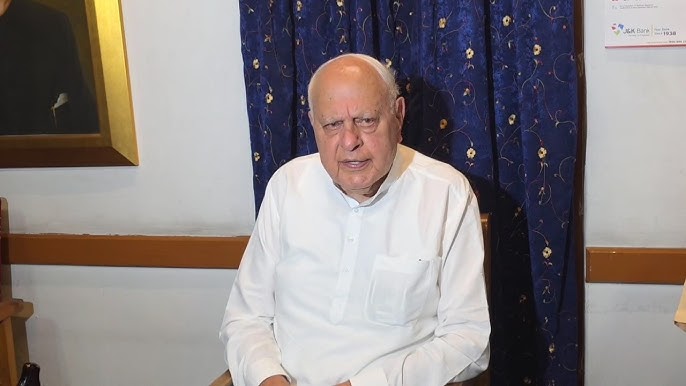
Srinagar: National Conference president and former Jammu and Kashmir Chief Minister Farooq Abdullah on Thursday described restoration of statehood as an “indispensable first step” towards rebuilding democratic institutions and restoring the constitutional and democratic rights of the people of Jammu and Kashmir.
Addressing a gathering in Srinagar, Abdullah said restoration of statehood was among the “most urgent necessities” facing Jammu and Kashmir.
“Restoration of statehood is an indispensable first step towards rebuilding democratic institutions and restoring the constitutional and democratic rights of the people,” he said.
Abdullah also expressed surprise over reports that employees appointed under the Prime Minister’s employment package had received threats.
Questioning why such threats were allegedly directed specifically at these employees, he said other government officers, including Hindus, and political leaders from different parties had not reportedly faced similar threats.
“There is something fishy in this, and it should be looked into,” he said.
The NC chief said the Ministry of Home Affairs should examine the matter, particularly since security arrangements in Jammu and Kashmir are under the Lieutenant Governor.
He also questioned the identity of those allegedly issuing threats through social media and urged authorities to investigate the matter.
Abdullah, however, acknowledged that Kashmiri Pandits continue to face difficulties and questioned the BJP over promises made to the community.
He said the Prime Minister’s employment package originated during the Manmohan Singh government and the tenure of Omar Abdullah as Chief Minister, when efforts were made to bring Kashmiri Pandits back, settle them and provide employment.
He said Kashmiri Pandits should not be confined to transit camps but should be able to live among the wider population.
“Kashmiri Muslims were never against them,” Abdullah said, adding that people knew who was responsible for their displacement.
Abdullah also stressed the importance of strengthening states, arguing that India’s strength lies in its diversity and federal structure.
He said excessive concentration of power at one place would weaken the country rather than strengthen it.
“If India has to be strong and has to grow, then the states must be made strong,” he said, adding that the problems faced by states must receive greater attention because that is where people live.
Reacting to the recently concluded Parliament session, Abdullah criticised the functioning of the House, saying Parliament had been weakened.
He said MPs raise questions and highlight public concerns, but answers are often not provided.
“Parliament is meant to bring people’s concerns forward,” he said, recalling his own experience as a Member of Parliament.
Abdullah said if the government does not pay attention to issues raised by elected representatives, disruptions and protests would inevitably follow.
Asked about the proposed protests by the group he referred to as the “Cockroach Janta Party” (CJP), Abdullah said such voices had brought attention to issues concerning alleged atrocities, tragedies, functioning of the judiciary and government institutions.
He said it was positive that such concerns were being raised and hoped the government would recognise the importance of the Constitution.
“The Constitution is the highest thing for every citizen of India, regardless of religion, language or the area they come from,” he said.
Abdullah also expressed concern over continuing violence and conflicts in Palestine, Lebanon, Iran and other parts of the world.
He condemned the killing of civilians, particularly children, women and elderly people, and expressed alarm over the destruction of hospitals, schools, universities, power stations and other essential infrastructure.
He said violations of fundamental human rights could not be justified and urged global powers to uphold universal principles and international law without applying double standards.
On the lack of coordination among Muslim countries, Abdullah said the absence of collective action was ultimately affecting poor and ordinary people.
He appealed to Muslim nations to rise above differences, strengthen cooperation and speak collectively for oppressed communities and innocent people facing violence and persecution.
The NC president reiterated that restoration of statehood was central to rebuilding democratic institutions in Jammu and Kashmir and restoring what he described as the constitutional and democratic rights of its people.
