



Deep Sharma
Jammu: The high-level government panel examining demographic changes in different parts of the country on Tuesday stepped up its fact-finding exercise in Jammu, visiting the Jagti township of displaced Kashmiri Pandits, inspecting a settlement housing Rohingya immigrants in Narwal and meeting delegations representing different communities.
The four-member committee, headed by Justice (Retd.) Prabhakar Navlekar, is on a three-day visit to Jammu and Kashmir to gather information on demographic changes, illegal immigration, settlement patterns and related issues.
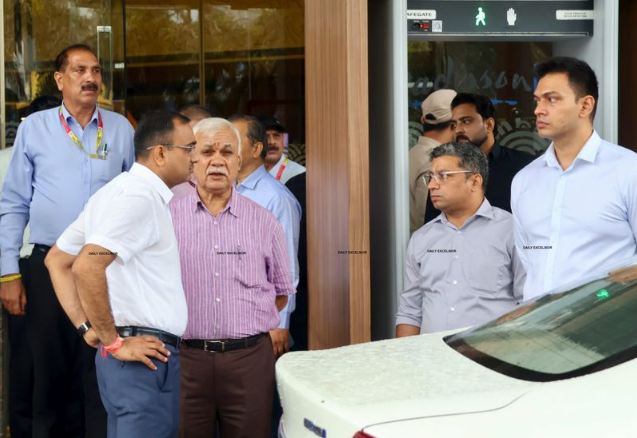
On the second day of its visit, the panel comprising Census Commissioner Mritunjay Kumar, former IAS officer Durga Shankar Mishra, former IPS officer Balaji Srivastava and economist Shamika Ravi visited Jagti township at Nagrota, one of the largest designated settlements for displaced Kashmiri Pandits in Jammu.
The members were given a traditional welcome by Kashmiri Pandit residents before holding a nearly hour-long closed-door interaction with community representatives.
Relief and Rehabilitation Commissioner (Migrants) Dr Arvind Karwani, who accompanied the committee, said the panel was meeting government officials as well as members of the public and different communities as part of its mandate.
He said the committee specifically visited Jagti to hear the concerns of Kashmiri Pandits, with more than 5,000 families residing in the township.
“Today, they specifically took out time to visit Jagti, where more than 5,000 families reside. They met the residents and interacted with them, listening very carefully to their sentiments and suggestions,” Karwani said.
Representatives of the displaced community raised issues concerning their return and rehabilitation, along with basic infrastructure and livelihood concerns.
Social activist Sunil Pandita said the delegation was briefed about problems faced by Kashmiri Pandits since 1990, including water supply, roads, sanitation, accommodation, employment, implementation of relief schemes and their return to Kashmir.
Another community representative, lawyer Vishva Ranjan Pandita, said he urged the Union government to recognise Kashmiri Pandits as victims and survivors of genocide and enact legislation on genocide. He also called for a safe and dignified return to their homeland, along with safeguards against a recurrence of the violence and displacement experienced in 1990.
The panel subsequently visited a Rohingya settlement in the Narwal area of Jammu before returning to its hotel, where several delegations met its members.
The committee also received submissions from representatives of the Gorkha community and refugees from Pakistan-occupied Jammu and Kashmir (PoJK), among others.
During interactions with civil society groups, the panel was also presented with concerns over alleged unauthorised settlements, encroachments and demographic changes in various parts of the Jammu region.
According to sources familiar with the deliberations, civil society representatives flagged areas including Jammu city, Samba, Kathua, Poonch and Ramban, besides parts of the Jammu-Srinagar corridor, and urged the committee to examine changes in population patterns and settlements.
The panel was also briefed about claims regarding the emergence of new residential clusters around Bathindi, Sidhra and the Tawi belt, as well as alleged unauthorised religious structures in and around Jammu city.
Some delegations alleged that illegal immigration and settlement of foreign nationals had contributed to demographic changes in parts of Jammu.
These claims formed part of the submissions made before the committee and are to be examined by the panel as part of its broader fact-finding exercise.
Sources also said the issue of Rohingya settlement in Jammu figured prominently in the discussions.
Various figures were presented to the committee regarding the number and spread of Rohingya and Bangladeshi nationals in the region.
Government data cited in the proceedings puts the number of foreigners, including Rohingya Muslims and Bangladeshi nationals, settled in Jammu and Samba districts at more than 13,700, with their population having increased by over 6,000 between 2008 and 2016.
In March 2021, police had identified more than 270 Rohingyas, including women and children, during a verification exercise in Jammu city. They were subsequently lodged at a holding centre inside Kathua Sub-Jail.
The committee’s mandate, however, extends beyond Rohingya and Bangladeshi settlements. The government has tasked it with scientifically assessing demographic changes in different parts of the country arising from illegal immigration and other factors, studying their causes and suggesting appropriate policy, legislative and administrative measures.
The panel is also examining issues concerning cross-border movement, identification of foreign nationals, verification of documents, settlement patterns and changes in population distribution.
The committee began its Jammu and Kashmir visit on Monday and held consultations with senior officials, including Chief Secretary Atal Dulloo and Director General of Police Nalin Prabhat.
The Centre constituted the panel in May under the chairmanship of Justice (Retd.) Prabhakar Navlekar.
The initiative follows Prime Minister Narendra Modi’s announcement of the “High-powered Demography Mission” on August 15 last year, with the Union Cabinet approving the proposal on September 11, 2025.
The committee’s findings are expected to feed into recommendations on how demographic changes linked to illegal immigration and other factors should be addressed.
After completing its Jammu and Kashmir visit, the panel is scheduled to travel to Punjab, Uttar Pradesh and Uttarakhand, where it will examine demographic changes and emerging settlements, particularly in areas considered sensitive from a security and migration perspective.
The Jammu visit has therefore brought together two distinct sets of concerns before the panel — the long-pending rehabilitation and return issues of displaced Kashmiri Pandits and concerns raised by civil society and authorities over foreign nationals, illegal immigration, documentation and changing settlement patterns.
The committee is expected to examine the submissions and official records before incorporating its findings into its final report.

