



NAVVNEET DUBEY
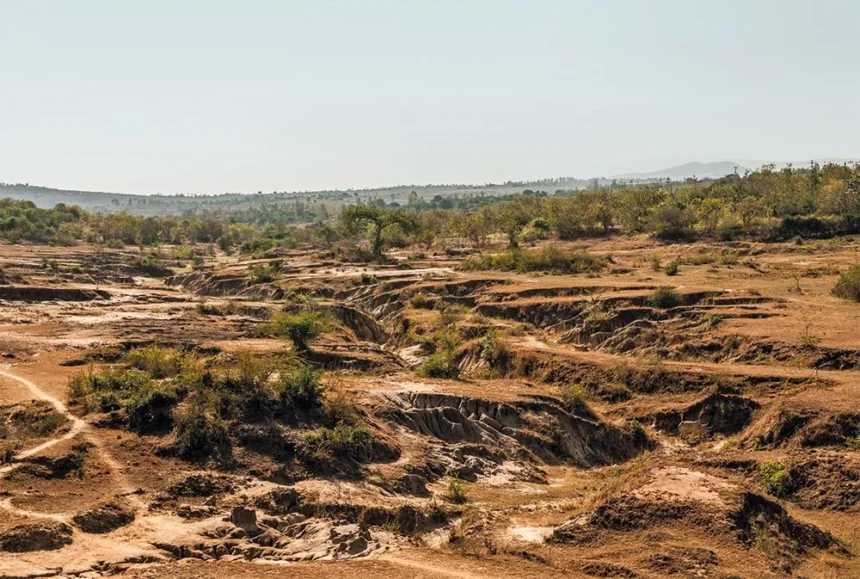
Jammu: The Desertification and Land Degradation Atlas of India (2021), released by the Government of India, indicates that 11,29,503 hectares of land in Jammu and Kashmir are affected by degradation. The figures were provided by the Ministry of Agriculture and Farmers’ Welfare in a written reply in the Rajya Sabha a couple of days back. Covering the period 2018–19, the data categorizes Jammu and Kashmir among the States and Union Territories with large tracts of land affected by degradation.
The Centre, however, stated that it has not conducted any assessment of agricultural land affected by degradation, nor of its specific impact on crop productivity, farm incomes, or food security. According to the State/UT-wise data, union territory has 11,29,503 hectares under land degradation, while neighbouring Ladakh has 71,11,968 hectares. Across India, the total area listed under land degradation stands at 9,78,54,851 hectares. The Ministry of Agriculture and Farmers’ Welfare said the 6.38 lakh hectares of land classified as manmade desertification and land degradation nationally in 2018–19 was identified through the Desertification and Land Degradation Atlas of India, published by the Space Applications Centre of ISRO.
The Government said the Indian Council of Agricultural Research (ICAR) has developed and recommended location-specific measures including contour cultivation, intercropping, crop rotation, conservation agriculture, mulching, green manuring, reduced tillage and agroforestry to promote soil restoration and sustainable land management.
For water conservation, measures include integrated watershed management, contour and graded bunds, stone bunds, trenches, bench terraces, check dams and farm and community ponds.
The Centre also said its National Innovations in Climate Resilient Agriculture (NICRA) project covers 651 districts and undertakes climate-change impact studies and district-level risk and vulnerability assessments. Of the 310 districts identified as vulnerable, 201 have been categorised as ‘High’ and 109 as ‘Very High’ climate-vulnerable.
District Agriculture Contingency Plans have been prepared for all 651 districts covered under NICRA, with recommendations for location-specific climate-resilient crops, varieties and management practices.
The Government further said climate-resilient technologies are being demonstrated in 448 Climate Resilient Villages across 151 vulnerable districts in 28 States and Union Territories. It added that ICAR released 2,900 crop varieties between 2014 and 2024, of which 2,661 are tolerant to one or more biotic or abiotic stresses.
Several schemes, including Per Drop More Crop, Rainfed Area Development, Soil Health and Fertility, Paramparagat Krishi Vikas Yojana, National Mission on Natural Farming and crop-diversification missions, are also being implemented to improve resource efficiency and agricultural resilience.
The Government said watershed interventions under the Watershed Development Component of the Pradhan Mantri Krishi Sinchayee Yojana include soil and moisture conservation, rainwater harvesting, drainage-line treatment, pasture development and livelihood support.
Despite land degradation and climate-related stresses, the Centre said overall agricultural production has continued to grow. Foodgrain production rose from 252.03 million tonnes in 2014–15 to a record 357.73 million tonnes in 2024–25, while horticulture production increased from 280.98 million tonnes to 370.73 million tonnes during the same period.

